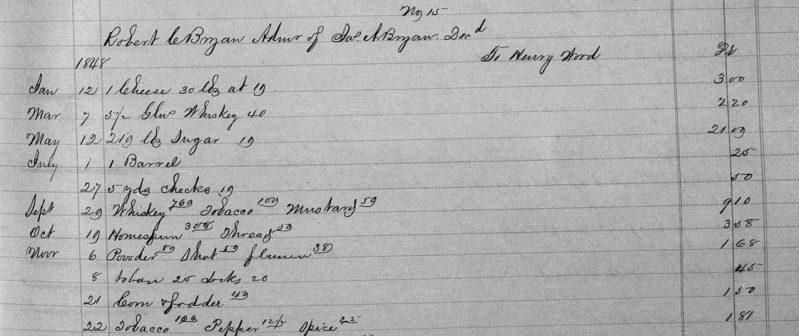
1847 – 1850 Returns
The machinery had not stopped. The man who built it was barely in the ground.
— Old Vouchers summary, Estate of James A. BryanJames A. Bryan died March 22, 1847. His son Robert C. Bryan, twenty years old, was appointed administrator six weeks later. What survives from the founding years of the estate is not a single annual return but 89 physically bundled vouchers — receipts, accounts, and payments spanning 1847 to 1850, with scattered entries from 1853, 1854, and 1859. Together they document a household in full operation: cotton going to market, shoes and blankets ordered for forty-plus people, children kept in school on the plantation, a gin house built board by board, and a rosewood piano arriving in the same accounting period as the gin house payment closed.
Seven bales to Scott Carhart & Co. through broker Hardeman & Hamilton — bales numbered J.A.B. 1 through 7, weights ranging 424 to 498 pounds, 10.25 cents per pound — $325.12. The cotton went to Macon. Robert signed for the receipt.
By the end of October, Ross & Co. had supplied bagging, rope, 21 pairs of shoes at 75 cents to a dollar each, and 12 blankets at $1.12½, along with homespun, calico, and iron. The estate received its winter provisioning for the plantation in the same week it sent its first bales to market.
Every bale the estate produced carried the brand J.A.B. — James A. Bryan. Even after his death, the cotton leaving the plantation bore his initials, pressed into the cotton before it left the gin house. Bales were numbered sequentially: #1–7 in October 1847, #56–64 in January 1848, #1–55 in the June 1848 sale.
Robert C. Bryan's personal cotton carried its own mark — R.C.B. — distinguishing what the administrator produced on his own account from what he produced for the estate. The dead man's initials moved down the Sandbed Road to Macon for years after his death.
The largest single cotton sale in the pre-war record: 55 bales to Scott Carhart & Co., brokered through John Jones & Son, 25,117 pounds at 5.5 cents per pound. After storage and commissions: $1,315.93 net.
Cotton was at 4.5 cents per pound in the fall of 1848. By October 1849 it had recovered past 10 cents. The estate that sold 55 bales at 5.5 cents in June 1848 watched the price nearly double by the following fall. The same gin, the same hands, the same road to Macon.
March 21–23, 1848: Thomas Gilbert delivers three days of structural lumber — 46 scantling, 100 weatherboards, planks of varying dimensions. December 18, 1849: Jacob Herring, who signs his receipt with his mark, is paid $133.98 for mechanics labor in building the gin house in the year 1849.
The lumber arrives in March 1848; the construction payment closes in December 1849. The gin house that Samuel Griswold would overhaul in 1853 — filing all fifty saw teeth and fitting a new shaft — was built across that eighteen-month gap.
Parr & Everett at Houston Manufacturing Co. receives from the estate: one ball of cotton, 472 pounds net at 6.75 cents, and two baskets, 80 pounds — $37.26 total. In return, the factory credits back: one bale of yarns, three bundles of yarn, and carding of 32 pounds of wool from November 1847. The net balance the estate owes: $3.46.
The plantation brought raw cotton and raw wool to the Houston Factory and received back spun yarn and carded fiber. The household's cloth was partly made from its own fields, processed a short distance away and returned in usable form.
The Bryan children were taught on the plantation by headmasters who came to instruct them together. Three teachers appear across the founding years: L.A. Hand in 1847 (five students, $76 total); Edward A. Harvey in 1849 (six students, $63.19¼ including books — Flint's Surveying, Webster's Spelling Book, Geography and Atlas, dictionaries); N.A. Hammer in 1850 (four students, $30.83).
Books purchased for Abner in December 1849 include Flint's Surveying and a Geography and Atlas — advanced texts suggesting he was the furthest along. James and Catharine received Webster's Spelling Books. Honora, approximately five or six years old, is enrolled for one quarter.
J.N. Hand's account, December 1847: visit to Servant (Woman) — $1.50. Manual examination — $5.00. Six months after James A. Bryan's death, an unnamed enslaved woman receives a medical examination costing the estate $6.50 — considerably more than Abner's tooth extraction that same year at 50 cents. Her name is not recorded. She is the single most significant undocumented person in the 1847 record.
Nancy boards in Macon at John Darby's school — later Monroe Female College, later Bessie Tift College. Her expenses in 1849 run through six separate vouchers: seven months board with John Pocke ($83), $19 store account, $35 for necessaries from Alfred Frost, $50 board from Alfred Frost, medical attention from E.A. Flewellen in June ($5), and three days of illness in October attended by Dr. P. Timberlake with a tooth extracted ($6). Robert also leaves $20 with a trusted intermediary for her use.
In October 1850, E. Lockwood charges $22 for dentistry — a substantial amount suggesting multiple procedures. Nancy's total documented expenditure for 1849 exceeds $200, more than any other sibling that year.
I.A. & S.S. Virgin, Macon: one rosewood piano with seat and cover, No. 37 — $260.00. The same month: a sofa from William Taylor ($50), a maple bedstead, and Jacob Herring's gin house payment of $133.98. The estate had $3,356.56 at interest that December.
The piano arrives in the same accounting period as the gin house closes out. The year's cotton income funded both the machinery and the music.
Wilson Smith's 1859 account: January 19, one pair of negro shoes, $1.50. September 23, 70 feet of plank to make a coffin, 75 cents. November 16, 30 pairs of negro shoes at $1.25 each, $37.50. The coffin appears between the shoe purchases as a single line. Seventy feet of plank is a full-sized coffin. No death in the Bryan family is documented for that date. The coffin is the only record of whoever was buried.
At their father's death, Troup and Hugh were living in LaGrange, Troup County. Geo. S. Eaton holds separate accounts for each: Troup's runs to gloves, cash loans, shoes, and rubber shoes ($16.65); Hugh's to shot, tobacco, cash loans, and blacking ($13.81). Both accounts are settled by Robert in November 1847. A third account covers Troup's travel expenses from LaGrange to Houston — $4.64 — suggesting he came home after the death. Troup is recorded as overseer in 1850 at $150.
L.D. Holmes marble: $149.40 — James A. Bryan's monument, nearly two years after his death. The same J.W. Holmes supplies cotton seed the following January for $40. The man and his monument and the seed for the next season's crop appear in consecutive years of the same ledger.
| Name | Year | What the record shows |
|---|---|---|
| Isaac | 1847–1850+ | Oct 29, 1847: 3 days work at J.C. White's — $6.00. The earliest named labor payment in the archive. Jan 1849: 8.5 days at J.G. White's smithy, part of a $19 blacksmithing account including shoeing and buggy work. A skill being built across the founding years — by 1852–53 he is hired out for full years, and by 1854 is at the coal kiln. 🚩 |
| Joe | 1848 | Apr 3, 1848: 4 days work at White's blacksmith shop — $8.00. Gun repairs and related ironwork. Appraised $700 in the 1847 inventory. By 1853 making collars and dickeys with Claiborne and Hodge. |
| Unnamed woman | 1847 | Sept 3, 1847: visit $1.50 and manual examination $5.00 from J.N. Hand. An unnamed enslaved woman receives a medical examination six months after James A. Bryan's death. Her name is not recorded in the document. 🚩 |
| 30+ unnamed | 1847–1850 | Fall 1847: Ross & Co. supplies 21 pairs of shoes and 12 blankets. Consistent fall provisioning across all years — 30 to 38 pairs of shoes annually — confirms the full scale of the plantation household. |
| Name | Year | What the record shows |
|---|---|---|
| Robert | 1847–1850+ | Age 20 when appointed administrator. Manages all cotton sales, provisioning, legal accounts, six siblings' schooling, and a medical practice simultaneously. Signs every major receipt in the record. The most documented individual in the archive. |
| Troup | 1847–1850 | In LaGrange at his father's death. Account at Geo. S. Eaton: gloves, cash loans, shoes, rubber shoes — $16.65, settled by Robert November 1847. Travel from LaGrange to Houston — $4.64. Tailor account at Bogle Fahy: silk cravat, cap. Recorded as overseer 1850 at $150. |
| Hugh | 1847–1850 | In LaGrange with Troup at his father's death. Account at Geo. S. Eaton: tobacco, shot, cash loans, blacking — $13.81. In Harvey's school December 1849 (4 months, 2 weeks). Coat cut by M. Kunz December 1850. Boards at J.G. White's. |
| Cornelius | 1849–1850 | Harvey's school December 1849: two quarters and three weeks. Coat and pants cut by M. Kunz December 1850. Boards at J.G. White's for nine months — $47. 🚩 |
| Nancy | 1847–1850 | Boards at John Darby's school in Culloden (later Monroe Female College). Board with John Pocke $83 for seven months plus $19 store account. Ill October 1849 — three days attended by Dr. P. Timberlake, tooth extracted, $6. Medical attention from E.A. Flewellen June 1849, $5. Dentistry from E. Lockwood October 1850, $22. Robert leaves $20 with a trusted intermediary for her use. Total documented expenditure 1849 exceeds $200. |
| Abner | 1847–1850 | Tooth extracted May 23, 1847 — 50 cents (J.N. Hand). Harvey's school December 1849. Hammer's school 1850. Books purchased December 1849: Flint's Surveying, Geography and Atlas, dictionary — the most advanced texts in the school account. Coat cut by M. Kunz December 1850. |
| Catharine P. | 1847–1850 | Shoes purchased August 29, 1849 at Smith & Jayne — $1.50. I.K. Nance's school 1847–1848. Harvey's school December 1849. Hammer's school 1850. Webster's Spelling Book purchased December 1849. Dictionary purchased same month. |
| James S. | 1847–1850 | L.A. Hand's school 1847. Harvey's school December 1849 — Webster's Spelling Book purchased. Hammer's school 1850. Elementary-level books in 1849 suggest he is among the younger students at that time. |
| Honora | 1849–1850 | Harvey's school December 1849 — one quarter, $4. Hammer's school 1850. Age approximately five or six years old at time of enrollment. The youngest child in the school record. |
| Name | What the record shows |
|---|---|
| Scott Carhart & Co. | Primary cotton buyer 1847–1848. Buys all three 1847 cotton transactions and the January 1848 sale. The 55-bale June 1848 sale is the largest single transaction in the pre-war record. |
| John Jones & Son | Primary cotton broker across most sales 1847–1849. Records every bale weight and number. G. Patten acts as his agent on individual sales. |
| Patten & Collins | Takes over as primary cotton broker from 1849 onward. Also supplies provisioning. Handles 46+ bales across multiple 1853 transactions. |
| Ross & Co. | Full-service provisioner and cotton broker. First purchase fall 1847: bagging, rope, shoes, blankets. Ribbon, edging, and kid gloves June 1847. Running account through multiple years. |
| Houston Manufacturing Co. | Wool carding and cotton-for-yarn exchange. First transaction November 11, 1847: 32 lbs wool carded. February 1848 exchange: raw cotton in, yarn back. Operated by Parr & Everett. Recurring relationship across multiple years. 🚩 |
| Charles Campbell & Co. | Provisioning — bacon, flour, whiskey, rice, bagging, rope, brogans, kerseys, calico. 25 pairs brogans October 1848 ($22.50), 3 pairs boys' brogans ($1.50). Large orders twice yearly. |
| J.G. White | Blacksmith and boardinghouse keeper. Isaac works here October 1847 and January 1849. Cornelius boards nine months 1850 ($47). Hugh boards. Recurring smithy services including buggy work and horseshoeing. |
| A.B. Horne | Blacksmith — rifle repair, horseshoeing, cotton screw clamp band September 1849, buggy repairs, ironwork. Running account $22.82. |
| Jacob Rhode | Overseer 1847 — $40 advance December 21, 1847; $72 for the year in account current. Order to Wilson Smith $41.41 July 1848. Distinct from Josiah Rhodes. |
| Josiah Rhodes | Overseer 1848 — $87.62 for the year. Signed receipt December 5, 1848. A second overseer, distinct from Jacob Rhode. |
| M.H. Means | Thomsonian botanical medicine — $31.25, December 13, 1847. Skunk cabbage, cohosh, lobelia, capsicum, nervine, sarsaparilla, aloes. First documented medicine supplier in the archive. 🚩 |
| M.S. Thompson | Second botanical medicine supplier September 1848 – March 1849. Cayenne, lobelia, mandrake, myrrh, bayberry, nervine — $27.26. |
| Wm. S. Townsend | Mixed medicine October 1849 — first quinine purchase in the record: 1 oz $5.00. Also cayenne, mustard. $7.20 and $38.16 in two accounts. 🚩 |
| J.N. Hand | Physician and schoolteacher. Abner's tooth extraction May 1847 (50 cents). Unnamed servant woman's examination September 1847 ($6.50). Botanical medicine account same year. |
| James R. Carnes | Attorney — $86.22 for defense of Lumpkin County land suit (Lot 753), December 18, 1849. Plus $20 for whiskey same day. |
| L.D. Holmes | Marble — $149.40, January 12, 1849. James A. Bryan's monument, nearly two years after his death. The same J.W. Holmes supplies cotton seed the following January at $40. |
| Wilson Smith | Multi-role across the entire record: Justice of the Peace, letter postage and post office agent, shoe and leather supplier. 1859: coffin lumber 70 ft (75 cents), 30 pairs negro shoes ($37.50). 🚩 |
| I.A. & S.S. Virgin | Macon piano dealers — one rosewood piano with seat and cover, No. 37 — $260.00, December 8, 1849. |
| Bryant Batton | Clerk of Court of Ordinary — all court filings across the estate record. Administration setup 1847 ($9.62). Annual return filings. 1853 attempted division ($1.75). |