1852 Return
34 documents · Full fiscal year · Houston County Court of Ordinary
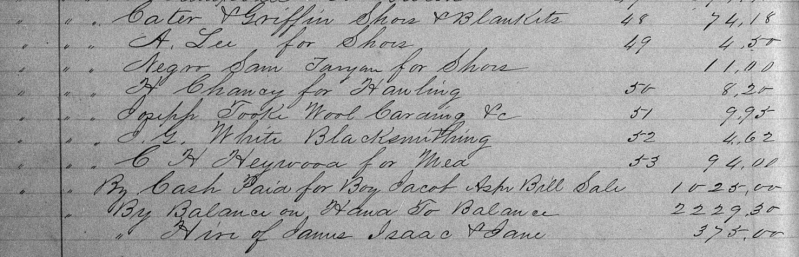
By Cash Paid for Boy Jacob as pr Bill Sale — $1,025.00.
— 1852 Annual Return, Estate of James A. Bryan, December 25, 1852Five years after James A. Bryan's death, the estate was running at full capacity. Robert C. Bryan — twenty-five years old in 1852 — managed ninety bales of cotton to market across five separate sales, kept four siblings in school, maintained a plantation household of forty-plus people, stocked a physician's pharmacy, and settled debts stretching back to his father's lifetime. The 34 documents of the 1852 return record a single fiscal year from December 31, 1851 to December 31, 1852 — the most complete and detailed annual return in the early estate record.
Eight bales in January at 7 cents. Thirty-two in October at 8¾ cents. Thirty-two more in November at 8⅛ cents. Eight in December at 7 11/16 cents. Ten more at year's end at mixed rates. Ninety bales total — $3,668 in cotton income across five transactions, brokered through J.B. Ross & Co. in Macon.
The cotton moved the same way it always had: Henry Chaney's wagon at twenty cents per hundred pounds, across the Toby Sofky toll bridge at $8 for the crossing, down the pale sand road to Macon. The brand on every bale was J.A.B. — James A. Bryan — the same initials that had left the gin house since 1847. Robert was twenty-five years old and he was running it.
Four words on the credit side of the ledger: Hire of James, Isaac & Jane — $375.00. Three people, hired out for the year, their combined labor worth $375 to the estate. Isaac had appeared once before in the record — October 1847, three days' work at J.C. White's smithy, seven months after James A. Bryan died. Here he is five years later, hired out for a full year alongside James and Jane.
The ledger does not say where they went or what they did. It says what they were worth. $375 for three lives for a year. James is listed first. Isaac is listed second. Jane is listed third. That is the full extent of what this document records about them.
Between a payment to Thomas W. Bell for a land deed and a sundries account at J.W. Mann & Co.: Negro Claiborne for horse collars — $2.00. This is the earliest confirmed appearance of Claiborne in the estate returns. He will appear again in March 1857, making horse collars. Again in December 1859. Again in 1860 and 1862, hired out with Charles and Matilda. Across ten years and five returns, the same man, the same skill, the same ledger catching him at the same moment.
The collars go on the horses that pull the cotton wagons to the Toby Sofky bridge. The cotton goes to Macon. The ledger moves on. Claiborne does not appear again in this return. He will be back.
The estate pays John Darby $124.75 for one term of tuition for Nancy A. Bryan — including music and practice with Miss Mills, Geography of the Heavens, Birritt's Philosophy, Moral Philosophy, Physiology, Geography and Atlas, copy books, paper, pens, natural theology, and a graduating fee of $3.00. Board with Harriet Lester costs $99. A personal account at J.W. Persons runs to $23.46 — shoes, muslin, edging, ribbon, otto of rose, a grass skirt, a pair of elastics, lace, bobinet, cambric. Gold cuff pins from Bryan & Holland, $3.50.
Nancy A. Bryan is graduating from John Darby's collegiate program in Macon in 1852 with first honor, studying subjects that place her in the intellectual tradition of the American female academy. The estate that employs ninety bales of cotton and hires out James, Isaac, and Jane for $375 is simultaneously paying for Geography of the Heavens. Both are in the same ledger, on the same pages, paid from the same account.
Robert C. Bryan was a physician administering a plantation, and C.H. Heywood's pharmacy account across 1851 and 1852 shows both roles simultaneously. The full-year account runs to $94: quinine purchased repeatedly across the year in one-ounce and two-ounce lots at $4.50 an ounce — the standard treatment for malaria — alongside castor oil, camphor, opium, ipecac, turpentine, lobelia, sarsaparilla, mustard plasters, syringes, pill boxes, vials by the dozen, liniment made to recipe.
The plantation sits on low ground near the Ocmulgee. Malaria was a seasonal fact. Robert bought quinine in quantity through every month of summer and fall. He was treating a household — the Bryan family and the people who worked the plantation both — and running the cost through the estate account.
A single line on the debit side of the ledger: By Cash Paid for Boy Jacob as pr Bill Sale — $1,025.00. Jacob is purchased on Christmas Day. The amount is the largest single expenditure in the 1852 return — larger than the overseer's wages, larger than the Macon sundries account, larger than the bacon purchase, larger than the Hardy Durham debt.
Jacob does not appear anywhere else in the 1852 record. He will appear in the 1861 estate inventory as Jako, valued at $1,100 — possibly the same person, nine years older, $75 more valuable to the appraisers. He was purchased on Christmas Day in 1852 and the ledger moved on.
R.I. Watson, overseer, receives $205 for the year's service. His receipt is signed with a cross — his mark — witnessed by the document. Andrew J. Watson could not write his name. The man responsible for the day-to-day management of a plantation running ninety bales of cotton, forty-some enslaved people, multiple hired-out laborers, a wool carding operation, blacksmithing, ditching, and a household with children in schools across middle Georgia — signed his annual receipt with an X.
The ledger records it without remark. Watson is paid $205. Robert C. Bryan, who graduated Mercer with first honor and studied medicine in Cincinnati, paid him in cash and kept the cross as documentation. G.B. Winget, paid $4.00 for a wagon axle the same month, also signed with his mark. Two mark-signers in a single return.
Hugh boards with J.G. White in Perry at $100 for the year and attends J.M. Colby's school. Cornelius is enrolled alongside him — tuition $43, and separately: Anthon's Greek Reader and Sophocles Grammar, $2.25. Two brothers from the Bryan plantation, studying ancient Greek in Perry, Georgia, in 1852, their school fees paid from the same cotton ledger that records ninety bales and a Christmas Day purchase.
Enslaved People
Every named individual appearing in the 1852 return. 🚩 marks a notable detail.
| Name | Year | What the record shows |
|---|---|---|
| Claiborne | Mar 1852 | Paid $2.00 for horse collars — earliest confirmed appearance in the annual returns. Will appear making horse collars again in 1857, 1859, and hired out in 1860–1862. This entry is the anchor date for his career in the record. 🚩 |
| James | Dec 25, 1852 | Hired out with Isaac and Jane for the year — $375 total for three. Listed first. Not yet identified in the 1847 inventory. |
| Isaac | Dec 25, 1852 | Hired out with James and Jane — $375 total for three. First appeared October 1847 — three days' work at J.C. White's smithy, the earliest named labor payment in the archive. The progression from a three-day hire in 1847 to a full-year hire in 1852 suggests an established skill. 🚩 |
| Jane | Dec 25, 1852 | Hired out with James and Isaac — $375 total for three. Listed third. |
| Jacob | Dec 25, 1852 | Purchased — Boy Jacob, Bill of Sale, $1,025. Largest single expenditure in the 1852 return. Purchased on Christmas Day. Possibly Jako in the 1861 estate inventory ($1,100) — and possibly Jac in the 1847 inventory ($700). If the same person, the ledger tracks him across fourteen years and three documents. 🚩 |
| Sam | Oct 28, 1852 | Shoes purchased — $7.00. Distinct from Sam Taryan, whose shoes are recorded separately on a different date. |
| Sam Taryan | Dec 25, 1852 | Shoes — $11.00, paid for work. Unusual double name in the record. Distinct from Sam above. |
Bryan Family
| Name | Role | What the record shows |
|---|---|---|
| Robert C. Bryan | Administrator / physician | Age 25. Managing the cotton operation, physician's pharmacy, four siblings' education, estate debts, and a dower application simultaneously. Signs every major receipt in the return. The most documented individual in the archive. |
| Nancy A. Bryan | Heir / student | Graduating John Darby's collegiate program in Macon with first honor. Tuition $124.75 including Geography of the Heavens, Music, Moral Philosophy, Physiology, Natural Theology, and a graduating fee. Board with Harriet Lester $99. Personal account at J.W. Persons $23.46. Gold cuff pins from Bryan & Holland $3.50. 🚩 |
| Hugh Bryan | Heir / student | Board with J.G. White in Perry $100. Tuition at J.M. Colby's school. Personal tobacco account at Felder Son & Co. Coat cut by M. King, tailor. Old account from Lewis Hines of Troup County settled — includes hat crape purchased April 1, 1847, nine days after his father's death. 🚩 |
| Cornelius Bryan | Heir / student | Enrolled at J.M. Colby's school alongside Hugh. Tuition $43. Studying Anthon's Greek Reader and Sophocles Grammar — $2.25 for the texts. |
| Troup Bryan | Heir | Receives $102.13 from the estate November 16, 1852 — six brood sows, seventeen shoats, and a portion of land sale in the 5th District. Signs his own receipt. |
| Catharine H. Bryan | Widow / dower applicant | Dower application filed Houston Superior Court — $7.00 court costs. Robert managing her legal interest as administrator. |
Businesses & Service Providers
| Name | What the record shows |
|---|---|
| J.B. Ross & Co. | Primary Macon cotton broker and provisioner. Two large supply accounts — $336.45 in February, $357.94 in December — covering bagging, rope, iron, sugar, coffee, whiskey, tobacco, homespun, calico, silk, gloves, boots, lard. Brokers all five cotton sales in the return. |
| Saml. Felder & Co. | Second major Macon supply account. February purchase $183.28 — linsey, jeans, cassimere, homespun, powder, shot, hooks, Nancy's shoes. Running account across multiple years. |
| C.H. Heywood / Cooper & Heywood | Physician's supply account — $40.62 for 1851 partial year, $94.00 for 1852 full year. Quinine purchased repeatedly: the largest medical spend in the record to date. Castor oil, camphor, opium, ipecac, turpentine, lobelia, mustard plasters, syringes, vials by the dozen. 🚩 |
| Joel Mann & Co. / J.W. Mann & Co. | Household furnishings and clothing — $122.94. Plates, pitcher, lantern, satinet, vest, neckwear, candlesticks, candles, pepper, wine, ewer and basin, linen, jeans, buttons, powder. Watch guard purchased — timepiece accessory. |
| C. Campbell & Co. | Bacon — $294.40. Large pork purchase provisioning the plantation for the year. |
| Patton & Collins | Bacon — $151.50 including freight and drayage. Two large bacon purchases in fall 1852, split between two suppliers. |
| Cater & Griffin | Shoes and blankets — $74.18. Purchased together in December, consistent with annual distribution to the plantation household. |
| John Darby | Macon collegiate program — Nancy's tuition $124.75 including music, philosophy, geography, and graduating fee. Nancy graduates with first honor, 1852. 🚩 |
| J.M. Colby | Perry school — tuition for Hugh and Cornelius $43. Sophocles Grammar and Anthon's Greek Reader purchased separately $2.25. |
| J.G. White | Blacksmith and boardinghouse keeper in Perry. Hugh boards for the year — $100. Blacksmithing account $4.62. Recurring presence across multiple returns. |
| R.W. Baskins | Neighbor and livestock supplier. Brood sow $6, January 1852. The same Baskins who gave Lenorrah to Frances E. Bryan as a wedding gift in 1850 and sold two mule colts to the estate in January 1851. |
| H.L. Wilson | Two mules — $175, note signed September, paid October. Second mule purchase of the year — substantial livestock investment. |
| Leroy Hanks | Two-horse wagon — $90, November 1852. Signed his own receipt. |
| Hardy Durham | Debt paid — $1,204.00, February 12, 1852. The largest single payment in the return. Nature of the debt unstated. Durham does not appear in any other document in the file. 🚩 |
| Thomas Malory | Paid $70 for ditching, February 1852. Substantial drainage work on the plantation. |
| Henry Chaney | Cotton hauler — $3.62 for four bales; $8.21 hauling cotton, gin, meat, and syrup from Macon December 24. The cotton's last leg before the toll bridge. |
| Jefferson Tankersly for I.B. Wiley | Toby Sofky toll bridge crossing — $8.00, January 1852. Bridge keeper collecting toll for owner Wiley. The same crossing documented in the 1847–1850 record and in the war years. 🚩 |
| W.A. & S. Tooke / Joseph Tooke | Mill operation — wool carding $3.60, lumber $4.70, wagon iron repair $1.65. The plantation's wool processed and returned in usable form. |
| Geo. S. Eaton | Troup County — Troup's account from 1848, tobacco, fish lines, coat, razor, cologne, shot, powder. Balance of $9.85 settled by Robert in March 1852, four years after the account was opened. |
| Lewis Hines | Troup County — Hugh's account from 1847: paper, tobacco, hat crape, cinnamon, shot. Balance of $8.32 settled April 1852, five years late. The hat crape was purchased April 1, 1847 — nine days after James A. Bryan died. 🚩 |
Prices recovered from the low of 5.5¢ in June 1848. Ninety bales at an average above 8¢ — the strongest cotton year in the early estate record.