1853 Return
28 documents · December 31, 1852 to December 31, 1853 · Houston County Court of Ordinary
He files fifty saw teeth, fits a new shaft, collects $48.50, and goes home. The cotton gin runs. The cotton is planted.
— 1853 Annual Return, Estate of James A. Bryan · Samuel Griswold, paid February 1853The 1853 return is a year of investment and maintenance. A fifty-saw cotton gin overhauled from shaft to brush. A carriage purchased. A piano tuned. A stethoscope added to a physician's supply account. Hired blacksmith labor brought in by the day to supplement the plantation's own ironwork. It is also the year Hugh Bryan closes his portion of the estate — taking his full distribution in cash, livestock, and four people — and leaves a credit on the books for the board of a wife whose name does not appear in the record.
Samuel Griswold is paid $48.50 for repairing the Bryan plantation's 50-saw cotton gin. The work is precise: filing all fifty saws, installing a new main shaft with two pulleys, fitting fifty-one new ribs in the breast, a new cotton box, new brush, boxes and pulley, main shaft boxes, back pulley shaft and boxes, hinges and screws, a band, a sliding mote board. The gin that processes every bale the estate sells is overhauled top to bottom.
Griswold's factory sat four miles east of Macon. He had made and repaired cotton gins there for years. When the war came, Confederate pistols were made at Griswoldville. In November 1864, Sherman's right flank came through and burned what was there — the depot, the factory works, everything. What Sherman left behind was ash. In the spring of 1853, Griswold filed fifty saw teeth, fit a new shaft, collected $48.50, and went home.
DeLoach, Wilcox & Co. receives $450 for a carriage and harness — the largest single expenditure in the 1853 return. More than the overseer's wages. More than Sally's purchase price. More than the full Macon sundries account at J.B. Ross. A carriage in 1853 middle Georgia was not merely transportation. It was position. The Sandbed Road runs past the house to the county seat, and Robert C. Bryan now drives it in a vehicle that cost nearly a quarter of the year's cotton income.
Robert C. Bryan is a physician administering a plantation, and the 1853 medical account at C.H. Heywood's pharmacy — $125.87 for the year, the largest in the returns to date — documents both roles at once. Quinine purchased nearly every month across summer and fall. Castor oil, opium, camphor, ipecac, turpentine, lobelia, sarsaparilla, mustard plasters, syringes, trusses, port wine, lemon syrup, pill boxes, vials by the dozen. And a stethoscope — a physician equipping a working practice with current instruments, treating the Bryan household and the plantation workers both, running the cost through the estate account.
Charles West bills the estate $27.12 for the hire of Billy Gunn, a negro blacksmith — three days in April, one in June, one in July, five in October, one in November, two days and additional work in December, at $1.62½ per day. Billy Gunn is not in the Bryan estate's inventory. He is brought in when the plantation's own blacksmithing capacity is not enough — gun repair, wagon work, farm equipment. He is among the most specifically documented workers in the 1853 return, named and dated across twelve months, and appears in it only because his labor was borrowed and billed by the day.
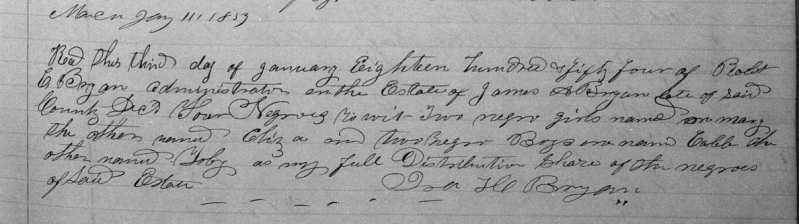
Hugh Bryan closes his portion of the estate in December 1853. The ledger records two cash receipts — $362.54 on December 30, and $125 on December 31 for the horse Rough & Ready — both signed in his own hand. On January 3, 1854, he receives his full distributive share of the estate's enslaved people: Toby, Mary, Eliza, and Caleb. The account current also carries a credit of $144 for the board of his wife and a master for twelve months at $12 per month — her name does not appear anywhere in the documents.
Toby had been in the estate since the 1847 inventory, listed alongside Clarasy at $825 for the two. Six years in the record between his first appearance and his last. He leaves with Hugh on January 3, 1854.
G.E. Schloth is paid $5 for tuning the piano — the rosewood instrument purchased from I.A. & S.S. Virgin in Macon in December 1849 for $260, still in active use four years on. An accordion had been purchased the previous year from S.B. Day for $15, with $5 of instruction alongside it. The piano will leave the house in 1856. In 1853 it is still here, and someone is playing it well enough to warrant a professional tuner.
Enslaved People
Every named individual appearing in the 1853 return. 🚩 marks a notable detail.
| Name | Date | What the record shows |
|---|---|---|
| Jacob | Dec 31, 1853 | Hired out in the year-end group — $690 total. Purchased Christmas Day 1852 for $1,025 and hired out within the same fiscal year. Possibly Jako in the 1861 inventory ($1,100). 🚩 |
| James | Dec 31, 1853 | Hired out in the year-end group. Also hired out in 1852. Third consecutive year in the hired-out record. |
| Isaac | Dec 31, 1853 | Hired out in the year-end group. First appeared October 1847 — three days' work at J.C. White's smithy, the earliest named labor payment in the archive. Now in his seventh year in the returns. 🚩 |
| Vester | Dec 31, 1853 | Hired out in the year-end group — first appearance in any document. Not in the 1847 inventory as documented. |
| Claiborne | Dec 30, 1853 | Paid for collars and dickey with Joe and Hodge — $7.50 total. Second confirmed return appearance; first alongside named companions. First appeared March 1852 making horse collars alone. |
| Joe | Dec 30, 1853 | Paid for collars and dickey with Claiborne and Hodge. In the 1847 inventory at $750. Appeared April 1848 at White's blacksmith shop. |
| Hodge | Dec 30, 1853 | Paid for collars and dickey with Claiborne and Joe. First appearance in the record. |
| Sally | Apr 9, 1853 | Purchased — Negro Woman, $380. An advertising cost of $3.25 precedes the purchase, suggesting a public sale rather than a private transaction. Not in the 1847 inventory. |
| Billy Gunn | Throughout 1853 | Hired blacksmith through Charles West — $27.12 for the year at $1.62½ per day. Not a Bryan estate enslaved person. Skilled ironwork documented across twelve months. 🚩 |
| Toby | Jan 3, 1854 | Distributed to Hugh Bryan. In the 1847 inventory alongside Clarasy at $825 for the two. Six years in the estate between first and last appearance. 🚩 |
| Mary | Jan 3, 1854 | Distributed to Hugh Bryan. Two Marys in the 1847 inventory ($700 and $450); which one is unclear. |
| Eliza | Jan 3, 1854 | Distributed to Hugh Bryan. In the 1847 inventory at $550. |
| Caleb | Jan 3, 1854 | Distributed to Hugh Bryan. In the 1847 inventory at $600. |
Bryan Family
| Name | Role | What the record shows |
|---|---|---|
| Robert C. Bryan | Administrator / physician | Managing cotton operations, a medical practice ($125.87 at Heywood's), gin overhaul, carriage purchase, and hired labor accounts simultaneously. Signs every major receipt in the return. |
| Hugh Bryan | Heir | Closes his portion of the estate December 1853. Receives $362.54 cash, horse Rough & Ready ($125), and four people — Toby, Mary, Eliza, and Caleb — on January 3, 1854. The account credits $144 for board of his wife and a master for twelve months; her name is not recorded. 🚩 |
| Nancy Bryan | Heir | $15 handed to her going to the springs, August 12, 1853 — a Georgia sulphur spring health resort. Clothing purchased in Macon, October 1853, $33.00 plus traveling expenses. Between her graduation from John Darby's collegiate program in 1852 and her marriage to W.M. Whitehurst in 1855. |
| Troup Bryan | Heir | Receives proceeds from sale of land in the 14th District, Lee County — $19.01 plus $2.25 traveling expenses to attend the sale. Signs his own receipt. |
Businesses & Service Providers
| Name | What the record shows |
|---|---|
| DeLoach, Wilcox & Co. | Carriage and harness — $450, May 3, 1853. The largest single expenditure in the 1853 return. 🚩 |
| C.H. Heywood | Physician's supply account — $125.87, the most extensive medical account in the returns to date. Quinine nearly every month. Castor oil, opium, camphor, syringes, trusses, port wine, sarsaparilla. Stethoscope purchased. 🚩 |
| Samuel Griswold | Gin repair — work done April 1852, paid February 1853, $48.50. Filing all fifty saws, new main shaft, fifty-one new ribs, new cotton box. Factory four miles east of Macon at Griswoldville — later manufactures Confederate revolvers; destroyed by Sherman's forces November 1864. 🚩 |
| Patten & Collins | Bagging, rope, twine, salt, rice — $118.87. Cotton broker: twelve bales sold October 24 at 8⅜ cents, $501.08. The year's largest single cotton transaction. |
| J.B. Ross & Co. | Macon sundries $150 (December) and cotton broker — eight bales at 9 cents, $326.05. Coat and hat for Hugh — $12.50. |
| N.B. Thompson & Son | Full-year dry goods — $104.82. French delaine, silk warp alpaca, and Irish linen alongside linsey, Georgia plains, and homespun. Plantation work cloth and household fashion in the same account. |
| Charles West | Bills $27.12 for hire of Billy Gunn across the year at $1.62½ per day. Gun repair, wagon work, farm ironwork. |
| Ezekiel Wimberly | Blacksmithing — three days in March, gun repair, 8.5 days across September and December. $18.03 total. Receipt signed by proxy, J.A. Tucker. |
| Henry Williams | Mechanic work — $25, June 28, 1853. Signed with his mark. The same Henry Williams who paints the house chrome green in December 1859 — two capacities, six years apart. 🚩 |
| W.B. Terry & Co. | Shoes and boots across three purchases — four pairs women's shoes $5.50 (May), two pairs men's boots $2.50 (October), one pair dress boots $7.00 (December). |
| M.F. Upham | Women's millinery — two bonnets with boxes $19.50, three caps $3.00. Macon, December 1853. |
| G.E. Schloth | Piano tuning — $5, June 1853. The rosewood piano purchased in 1849 for $260, still in active use. 🚩 |
| S.B. Day | Accordion $15 and instruction $5 (1852 account settled 1853). Compass repair $9.00. |
| Jefferson Tankersley for J.B. Wiley | Toby Sofky toll bridge — $9.00, January 1853. Rate increased from $8.00 the prior year. |
| Georgia Citizen | Publishing legal notice for Lee County land sale — $3.00. Annual subscription — $2.00. |
| John H. Powers | Ordinary — recording and receiving returns and vouchers for 1851 ($8.40). Order for dismission and certificate — $2.25 total, November–December 1853, related to Hugh's closing of his portion of the estate. |
Two sales documented in 1853 — 20 bales total. Prices holding above 8¢ for the second consecutive year, the strongest sustained run in the early estate record.