1854 Return
26 documents · December 31, 1853 to December 25, 1854 · Houston County Court of Ordinary
Seven dollars handed to Abner going to school. Nine years later: seven dollars and fifty cents handed to Abner going to war.
— 1854 Annual Return, Estate of James A. Bryan · February 13, 1854 / January 20, 1863The 1854 return is the largest cotton year in the record so far — seventy-eight bales, $3,066 in cotton income, the gin that Samuel Griswold overhauled running through a full season. It is also the year someone in the household sat for a daguerreotype, Abner went off to school, two people distributed to Hugh the previous January were hired back to the same plantation by December, and nine working animals were in harness on the plantation grounds simultaneously.
The largest cotton year in the returns to date. Fifty-four bales sold February 3 to F.S. Bloom through Patten Collins & Co. — 25,121 lbs at 8½ cents, $2,111 net after storage, mending, and commission. Eight more bales February 24 at 7¾ cents, $314.58. Sixteen bales in October — thirteen to Knott & Hollingsworth at 8¾ cents and three at 7 cents, $641 net. Seventy-eight bales total, $3,066 in cotton income across four transactions.
Each bale went down the Sandbed Road to the Toby Sofky bridge, across to the Macon road, to Patten Collins & Co. on Cotton Avenue. Each bale weighed and numbered sequentially — bale 1 through bale 78. Every pound accounted for. The cotton gin Griswold overhauled in 1852 ran through the summer of 1854 and produced this.
Seven dollars handed to Abner going to school. He is eighteen years old. J.E. Crosland's school will bill the estate $134.40 for two terms of tuition, nine months of board, washing and lights, Greenleaf's Arithmetic, Weld's Parsing, Quackenbos Composition, Latin Reader, University Arithmetic, pens and ink.
Nine years later, January 20, 1863, the ledger records seven dollars and fifty cents handed to Abner going to war. The amounts are nearly identical. The ledger uses almost the same language both times — cash handed to Abner, the destination following. In 1854 the destination is a schoolroom. In 1863 it is the Confederate Army.
William B. Daniels receives $27 for daguerreotypery. Someone in the Bryan household sat for a formal portrait in late May 1854. Twenty-seven dollars is a substantial sum for a single photograph — more than Abner's school money, more than the annual blacksmithing account. The document does not say who sat or how many plates were made. The payment comes from the estate account. The sitting was in late May — spring, good light, before summer heat.
The estate is producing seventy-eight bales of cotton. Abner is at Crosland's school. Catharine P. is at Holtzclaw's. The carriage is on the road. Someone decided this was a moment worth preserving on silver. That photograph may still exist.
January 3, 1854: Hugh Bryan receives Caleb and Eliza as part of his distributive share of the estate's enslaved people. He takes them away. December 20, 1854: Hugh Bryan receives $200 from the estate for the hire of two negroes, Calip and Eliza. Calip is Caleb. Eliza is Eliza. Less than twelve months after receiving them as his property, Hugh is hiring them back to the estate they came from.
The ledger records both transactions without connecting them. They are connected.
Ned and Isaac are paid $7.00 for coal. The kiln is running. Isaac has been in the record since October 1847 — now in his eighth year, appearing at intervals in specific work. In 1847 three days at a neighbor's smithy. In 1852 and 1853 hired out for full years. Now at the kiln with Ned, producing charcoal for sale and for the plantation's own blacksmithing operations. Red, Bob, and Jake will be doing the same work in 1860. The kiln runs across the full decade of these returns. Isaac is present at the early end; others take it forward.
J.G. White bills the estate $7.87 for nine pairs of hames — the curved pieces that fit into a draft horse's collar and attach the traces. Nine pairs means nine working animals in active harness simultaneously. The same account includes horseshoeing four times, a screw plate, and hame repair — the full maintenance cycle of a working draft animal operation. Peter is paid $1.12 for horse collars in May. The harness gear for nine animals running continuously through the cotton season.
Enslaved People
Every named individual appearing in the 1854 return. 🚩 marks a notable detail.
| Name | Date | What the record shows |
|---|---|---|
| Isaac | Mar 26, 1854 | Paid $7.00 with Ned for coal at the kiln. Eighth year in the returns — first appeared October 1847. Hired out 1852 and 1853. Now producing charcoal on the plantation grounds. 🚩 |
| Ned | Mar 26, 1854 | Paid $7.00 with Isaac for coal at the kiln. First appearance in the returns. |
| Peter | May 27, 1854 | Paid $1.12 for horse collars. Claiborne received $2.00 for the same work in 1852 — different person, same craft, different rate. |
| Caleb / Calip | Dec 20, 1854 | Distributed to Hugh Bryan January 3, 1854. Hired back to the estate by Hugh by December 20 — $200 for the year with Eliza. In the 1847 inventory at $600. 🚩 |
| Eliza | Dec 20, 1854 | Distributed to Hugh Bryan January 3, 1854. Hired back to the estate by Hugh by December 20 — $200 for the year with Caleb. In the 1847 inventory at $550. 🚩 |
Bryan Family
| Name | Role | What the record shows |
|---|---|---|
| Robert C. Bryan | Administrator / physician | Managing the largest cotton year in the record, two school accounts, mule purchases, medical supplies, and a daguerreotype sitting — all from the same estate account. Medical account at M.S. Thomson $46 settling supplies from 1851–1853. |
| Hugh Bryan | Heir | Receives $1,142.15 final distributive payment. Also paid $200 for overseeing the estate in 1853, and $200 for hire of Caleb and Eliza December 20. Total received from the estate in 1854: $1,542.15. 🚩 |
| Abner C. Bryan | Minor / student | $7 handed to him going to school, February 13. J.E. Crosland's school: two terms tuition, nine months board, washing, Greenleaf's Arithmetic, Latin Reader, Quackenbos Composition, pens and ink. $134.40 total. 🚩 |
| Catharine P. Bryan | Minor / student | Tuition at H.M. Holtzclaw's school — $55.38. Age approximately 16. In school while Abner is at Crosland's. |
| Nancy Bryan | Heir | Shoes purchased by Robert on the same October shopping trip as a hat for himself — $1.50. One of her last appearances in the returns as a Bryan ward before her marriage to W.M. Whitehurst in 1855. 🚩 |
| Troup Bryan | Heir | $12.00 for cutting — timber cutting on a land parcel, April 1854. |
Businesses & Service Providers
| Name | What the record shows |
|---|---|
| Patten Collins & Co. | Primary cotton broker — 54 bales February ($2,111 net to F.S. Bloom), 16 bales October ($641 net to Knott & Hollingsworth). Also bacon supplier — 505 lbs sides $63.12. Dual role as commodity broker and provisioner continuing from prior years. |
| J.B. Ross & Co. | Full-year account covering farm tools (axes, hoes, castings, spades, shovels), provisions (sugar, coffee, tobacco), and dry goods (hats, shoes, iron, sheeting, osnaburgs, kersey, socks, rope). Quinine purchased December — malaria season treatment. |
| J.E. Crosland | School — Abner's two terms tuition, nine months board, washing and lights, textbooks and supplies. $134.40 total. Perry area. 🚩 |
| H.M. Holtzclaw | School — Catharine P. Bryan's tuition, $55.38. |
| W.B. Daniels | Daguerreotypery — $27, May 25, 1854. Macon. The most expensive single personal purchase in the 1854 return. 🚩 |
| James Robinson | Two mule purchases — one black mule $130 (March), another mule $150 (September). Two separate transactions from the same seller in one year. Continuous expansion of the plantation's draft animal stock. |
| J.G. White | Nine pairs of hames $7.87 (1853 account settled 1854), horseshoeing four times, screw plate, hame work. Peas credit of $8.00 applied. Smith and produce exchange. |
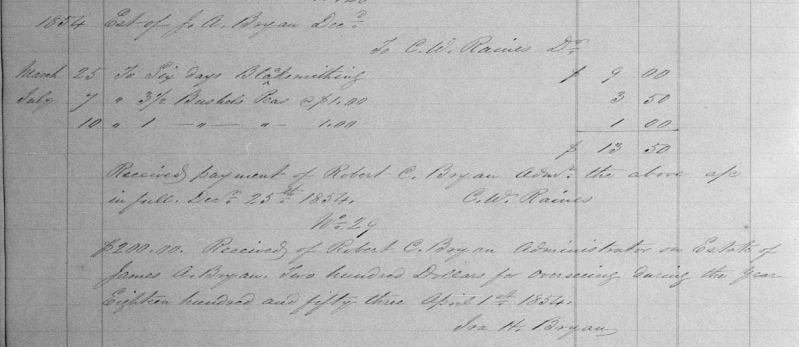
| C.W. Raines | Blacksmithing — six days, $9.00. Also sold peas to the estate — $4.50. Dual role as smith and small produce supplier. |
| M.S. Thomson | Botanical medical supplies 1851–1853, settled April 1854 — $46.00. Lobelia, cayenne, prickly ash, podophyllin, unicorn, skullcap. A distinct medical tradition from Heywood's allopathic pharmacy — Robert purchasing from both suppliers across the same years. 🚩 |
| W.B. Terry & Co. | Two seasonal shoe purchases — $6.25 in February, $6.25 in October–November. Spring and fall provisioning continuing the pattern from prior years. |
| Leary Stanley | Ten stock hogs $40 (November); seed potatoes $7. Regular small livestock and produce supplier. |
| D.B. & Wm. Cunyus | Cross cut saws, scoops, wedge — $7.20. Timber and field cutting tools, December 1854. |
78 bales — the largest single-year cotton production in the returns to date. The bulk February sale of 54 bales at 8½¢ drove the year's income. Prices steady above 7¢ across all four transactions.