1855 Return
40 documents · December 25, 1854 to February 2, 1856 · Houston County Court of Ordinary
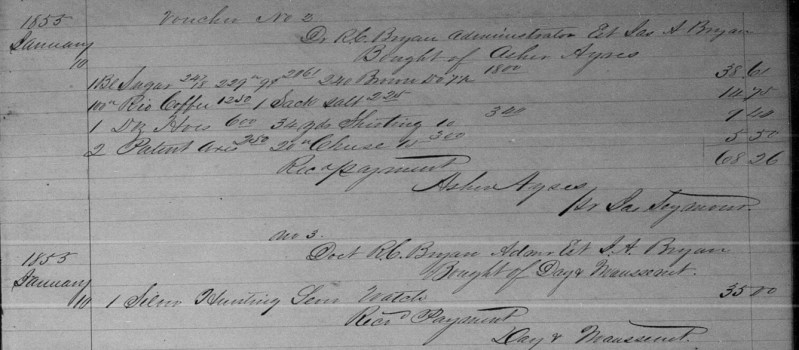
One silver hunting lever watch — $35.00. One dozen hoes. Two patent axes. Twenty pounds of cheese. Same account. Same morning.
— 1855 Annual Return, Estate of James A. Bryan · January 10, 1855The 1855 return covers fourteen months — the most document-rich return in the record at 40 vouchers. The cotton harvest runs large across multiple sales. Six people are hired out for the year. A boy is purchased in April for $1,250, the largest single purchase in the returns to date. The gin is repaired. The well is repaired. A watch is bought on the same morning as a dozen hoes. Cornelius Bryan is running estate errands in Macon. Abner Bryan is in his second year at Crosland's school, studying chemistry and geometry. Robert C. Bryan is twenty-eight years old.
Ross & Brother delivers 38 pairs of shoes at $1.20 each — $45.60. Sixty and three-quarter yards of kersey at 28 cents — $17.01. The shoes and the kersey arrive together in October, the same time each year: fall provisioning before winter, distributed to the plantation household before the cold comes. Thirty-eight pairs of shoes means at least thirty-eight people receiving footwear on the same day. The kersey goes to the seamstresses who will cut and sew the winter clothing.
These two line items are the closest the returns come to documenting the plantation's annual provision of its people: the shoes measured in pairs, the cloth measured in yards, the timing deliberate. They appear between a coil of rope and a keg of oysters, in the same account that carries cotton brokerage and iron and bacon. The ledger does not distinguish between them.
A single day's purchasing in Macon. From Asher Ayres: 229 lbs of sugar, 240 lbs of bacon, 100 lbs of Rio coffee, a sack of salt, a dozen hoes, 34 yards of shirting, two patent axes, 20 lbs of cheese — $68.26. From Day & Maussent on the same day: one silver hunting lever watch, $35.00. The watch costs more than the hoes, the axes, and the cheese combined. The same morning's receipts buy both the tools that work the land and the instrument that measures the day. Both charged to the same estate account.
Cash for boy Bob as per bill of sale — $1,250.00. The largest single purchase in the 1855 return, and the largest enslaved person purchase in the returns to date — $225 more than Jacob in 1852. Robert traveled to and from Alabama on estate business the same day, expenses $28.50 — suggesting the purchase was made out of state. Bob does not appear elsewhere in this return. He will appear at the coal kiln in 1860.
Hire of James, Isaac, Pete, Jacob, May, and Jane — $800.00 for the year. Six people, the largest hired-out group in the returns to date. Isaac and James have been in the hired-out record since 1852. Jacob was purchased Christmas Day 1852 and has been hired out in consecutive years since. Pete, May, and Jane appear here for the first time in this context. The ledger records the total and the names and moves on.
Second year at J.E. Crosland's school: tuition $32, board $110, Davis's Bourdon (mathematics), Young's Chemistry, Davis's Legendre (geometry) — $147.00. His first year covered Latin, arithmetic, and composition. Now he is studying higher mathematics and chemistry. Two years at Crosland's total $281.40. Cash sent to him at school twice during the year — $2.00 in August, $2.00 in September.
Alex M. Thigpen receives $6.25 for repairing the cotton gin — a maintenance call following Griswold's full overhaul in 1852. Joseph Cooke & Son repairs the cotton screw in the same year. The gin and the screw together are the mechanical sequence that turns picked cotton into baled cotton ready for market. Both require attention every one to two years to keep the harvest moving.
Among a J.W. Mann purchase that includes waffle irons, hatchets, tin trays, linen, a molasses jug, and nails: one pair of oars, $2.00. There is a boat on this property, or regular access to one. The physical record describes the land dropping into a valley below the Sandbed Road, with a spring under the hill. A pair of oars suggests something larger than a wading brook — a creek or pond deep enough to row. The purchase is unremarked, listed between the hatchet and the tin trays. Someone rowed on this ground in 1855.
The C.H. Heywood medical account settled in this return includes chloroform and sulfuric ether alongside the familiar quinine, opium, and castor oil. Chloroform and ether are surgical anesthetics. The stethoscope in 1853, the chloroform and ether in 1854, and the continued quinine purchases across every summer document a fully equipped rural medical practice running alongside the estate administration. Robert C. Bryan is treating patients, not just managing a plantation.
Enslaved People
Named and documented individuals appearing in the 1855 return. 🚩 marks a notable detail.
| Name | Date | What the record shows |
|---|---|---|
| Bob | Apr 14, 1855 | Purchased — Boy Bob, Bill of Sale, $1,250. Largest enslaved person purchase in the returns to date. Robert traveled to and from Alabama on estate business the same day. Will appear at the coal kiln in 1860. 🚩 |
| James | Feb 1855 | Hired out — $800 total for six. Fourth consecutive year in the hired-out record. |
| Isaac | Feb 1855 | Hired out — $800 total for six. Ninth year in the returns. First appeared October 1847. Hired out continuously since 1852. 🚩 |
| Pete | Feb 1855 | Hired out — $800 total for six. First appearance in a hired-out entry. |
| Jacob | Feb 1855 | Hired out — $800 total for six. Purchased Christmas Day 1852 for $1,025; hired out in consecutive years since. |
| May | Feb 1855 | Hired out — $800 total for six. First appearance in the returns. |
| Jane | Feb 1855 | Hired out — $800 total for six. First appearance in a hired-out entry. |
| 38 unnamed | Oct 17, 1855 | 38 pairs of shoes from Ross & Brother — $45.60. Annual fall distribution to the plantation household. Consistent with 43 pairs in 1853. 🚩 |
| Plantation household | Oct 1855 | 60.75 yards kersey for winter clothing — $17.01. 20 blankets and 308.5 yards osnaburgs from the prior year also settled in this return. Annual provisioning cycle confirmed across multiple years. |
Bryan Family
| Name | Role | What the record shows |
|---|---|---|
| Robert C. Bryan | Administrator / physician | Managing a 14-month fiscal year — multiple cotton sales, six hired out, one purchase, gin and well repairs, two school accounts, medical supplies from two different traditions. Medical account at Heywood's $51.99; botanical supplies from S.N. Shannon & Co. January 1856. Order for division filed December 14, 1855 — $1.00 recording fee, $1.25 certified copy. |
| Abner Bryan | Student | Second year at J.E. Crosland's — tuition $32, board $110, Davis's Bourdon, Young's Chemistry, Davis's Legendre. $147.00. Cash sent twice during the year. Two years at Crosland's total $281.40. 🚩 |
| Catharine P. Bryan | Student | Board at Samuel D. Villines for year 1854, $85 — settled February 1855. Separate from tuition at H.M. Holtzclaw's. |
| Cornelius Bryan | Heir | Running estate errands in Macon — expenses recorded twice in the return. Witnesses a receipt for the estate, March 23, 1855. 🚩 |
Businesses & Service Providers
| Name | What the record shows |
|---|---|
| Ross & Brother | Largest single vendor account in the returns to date — $339.71 across the extended year. Full plantation provisioning: osnaburgs (618.5 yards), homespun, syrup, sugar (235 lbs), bacon (1,003 lbs), saddle, hoes, shoes, rope, bagging, kersey, salt, oysters, quinine, rice. 🚩 |
| Day & Maussent | One silver hunting lever watch — $35.00, January 10, 1855. Macon jewelers. Most expensive single personal purchase in the 1855 return. 🚩 |
| Asher Ayres | January 10, 1855 — sugar, bacon, coffee, salt, hoes, shirting, axes, cheese — $68.26. Same day as the watch purchase. |
| Patten Collins & Co. | Cotton brokerage across multiple sales in the extended year. Also bagging, rope, salt, twine, wagon repair, bacon (11 sides and 34 shoulders). Dual provisioner and broker role continuing. |
| N.B. / H.B. Thompson & Son | Running dry goods account 1852–1855, settled January 1855 — $177.67. Kersey, delaine, alpaca, Irish linen, linsey, Georgia plains, calico, muslin, mourning calico, homespun. Mourning calico purchased February 1853 noted in the account. 🚩 |
| J.W. Mann | Running household account — $58.79 settled January 1855, $23.77 continuing. Brass candlesticks, waffle irons, oars, hatchet, tin trays, linen, molasses jug, nails, boots, knives and forks, curry combs, wool cards, blanket. The most diverse single household account in the returns. |
| C.H. Heywood | Medical account $51.99 (1855). Prior 1854 account includes chloroform and sulfuric ether — surgical anesthetics. Quinine across summer and fall months. 🚩 |
| S.N. Shannon & Co. | Botanical medical supplies, January 1856 — $12.00. Lobelia, leptandrin, cayenne, nerve powder, ginger. Thomsonian tradition continuing alongside Heywood's allopathic account. |
| Alex M. Thigpen | Cotton gin repair — $6.25, June 13, 1855. Maintenance following Griswold's 1852 overhaul. |
| Joseph / W.A. Cooke & Son | Lumber (cypress planks, scantling, laths), cotton screw repair, cart wheel bushing — $21.62. |
| Samuel D. Villines | Board for Catharine P. Bryan year 1854 — $85.00, settled February 1855. |
| Strong & Wood | 1853: 36 pairs men's shoes, 6 boys', 1 child's — $52.25 — the largest single shoe purchase in the returns. 1855: one pair boots $4.50. |
| Jefferson Tankersley for S.B. Wiley | Toby Sofky toll bridge — $8.00, January 1855. Same crossing documented across every return in the record. |
| William B. Cox | Well repair — $5.00, July 24, 1855. Water supply infrastructure maintenance. |
Extended year with multiple sales across two cotton seasons — January 1855 bales from the 1854 harvest, September onward from the 1855 harvest. Prices ranged from 6½¢ to 9¢ across the fourteen months.