1856 Return
36 documents · February 2, 1856 to January 15, 1857 · Houston County Court of Ordinary
The piano was purchased in December 1849 for $260. On March 1, 1856, it left the house for $260. Seven years. Same price.
— 1856 Annual Return, Estate of James A. Bryan · March 1, 1856The 1856 return is the distribution year. On March 1, land, livestock, and personal property are formally divided among the heirs. The rosewood piano leaves the house. Fifty-two bales of cotton go to market across four buyers, prices ranging from 8¼ to 12⅛ cents in a single season. Three students are in school. Cornelius Bryan is overseeing the plantation's day-to-day operations. In December, Abner Bryan travels to the Macon jail. The estate that distributed its assets in March is purchasing cotton seed in December for the following year's crop. The plantation does not pause between distribution and planting.
On March 1, 1856, the formal distribution of the estate of James A. Bryan is recorded. Wilkinson M. Whitehurst — Nancy's husband — receives his distributive share: land for $681, mule Martha for $130, and the rosewood piano for $260. The piano was purchased from the Virgin Brothers in Macon in December 1849 for $260. It was tuned by G.E. Schloth in June 1853 for $5. It was being maintained and played through 1855. On March 1, 1856, Whitehurst pays the same price for it that the estate paid in 1849 — it has held its value exactly across seven years.
The piano leaves the Bryan house on the Sandbed Road and does not return. Everything else distributed that day — mules, horses, plows, land parcels — is also divided. But the piano is the only item in the distribution that had already been named in the record, already placed in the household, already connected to the life of the house. Its departure closes something the documents had been building since 1849.
The 1856 cotton harvest moves to market in five separate transactions through two brokers. Eight bales in September to D.R. Rodgers at 10½ cents — $406.03 net. Eight more to Knott & Hollingsworth at 8¼ cents — $316.70. Eight bales in October to John S. Nelson at 12⅛ cents — $467.48. Twenty-one bales in December to Atha & Granniss at 11⅝ cents — $1,158.73. Seven more through Adams & Reynolds at 11⅝ cents — $382.80. Fifty-two bales total, $2,731 in cotton income.
The price variation — 8¼ to 12⅛ cents in a single season — reflects timing, bale quality, and market conditions month by month. Each bale is numbered and weighed to the pound. The estate that formally divided its land and personal property in March is running its largest bale count since 1854 through the fall.
Cornelius Bryan receives $234 for overseeing the plantation in 1856 and $180 for the hire of two people — $414 total, paid January 5, 1857. He was running estate errands in Macon in 1855, witnessing receipts, a visible operational presence. By 1856 he is formally the overseer — the man responsible for day-to-day plantation management while Robert administers from the same property. The two brothers divide the estate's labor: Robert handles the ledgers, the brokers, the court filings, the medical practice; Cornelius manages the field operations and the hired-out arrangements.
J.E. Crosland receives $115 for the tuition of James S. Bryan — one year at $24, board for nine and a quarter months at $90, Davies' Arithmetic and Weld's Grammar at $1. Abner studied Latin, advanced mathematics, and chemistry at Crosland's across 1854 and 1855. James S. is working through arithmetic and grammar — the foundational curriculum, a younger student in the same schoolroom, his board and instruction paid from the same estate account.
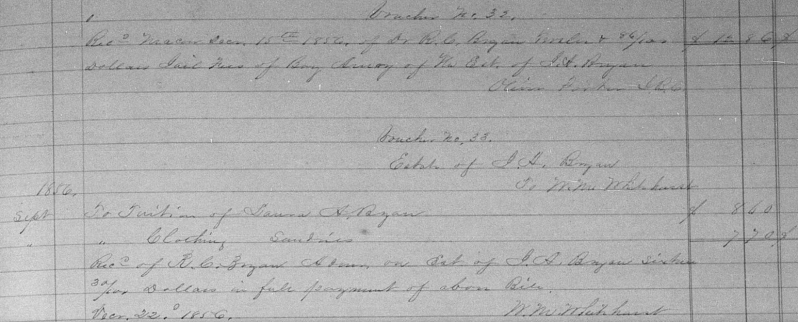
Oliver Porter, Justice of the Inferior Court, receives $12.86: jail fees for Boy Avery of the Estate of J.A. Bryan. On the same date the ledger records $1.75 in expenses for Abner Bryan to and from the Macon jail. The charges against Avery and the circumstances are not stated in the document. Abner makes the trip — the estate pays both the fees and the travel. The jail fees are recorded between a blacksmith bill and a tuition payment, as a routine expense. Oliver Porter signs the receipt. The ledger moves on.
D.H. Jackson receives $36.75 for one ton of cotton seed. This is not a sale — it is a purchase. One ton plants roughly 30 to 50 acres. The estate distributed its land and personal property in March. It sold fifty-two bales through the fall. It is paying school tuition for three students. And in December it is buying seed for a crop that will not be harvested until the following autumn. The estate continues operating through its own distribution. The land keeps its cycle regardless of what the ledger records about ownership.
E.J. Johnston & Co. receives $10.00 for one ladies pin. A single decorative pin, $10 — charged to the estate account in September, the same month eight bales of cotton sell for $316 and the Asher Ayres provisioning order goes out for kersey and mackerel. Someone in the household wanted this pin enough for Robert to put it on the estate account. The ledger records it without elaboration, between a blacksmith account and a cotton transaction, as it records everything else.
Enslaved People
Named and documented individuals appearing in the 1856 return. 🚩 marks a notable detail.
| Name | Date | What the record shows |
|---|---|---|
| Avery | Dec 15, 1856 | Jail fees — $12.86 paid to Oliver Porter, Justice of the Inferior Court. Receipt reads: "Boy Avery of the Est of J.A. Bryan." Charges and circumstances not stated. Abner Bryan travels to the Macon jail the same day — $1.75 expenses. May be Amos from the 1847 inventory ($500) — if so, nine years between inventory and jail entry. 🚩 |
| Two unnamed | Jan 5, 1857 | Hired out through Cornelius Bryan — $180 for two for the year. Part of Cornelius's overseer arrangement. |
| 20 unnamed | Dec 2, 1856 | 20 blankets from J.B. & W.A. Ross — $22.50 at $1.12½ each. Annual winter provisioning. Same quantity as 1855 — consistent household size across years. 🚩 |
Bryan Family
| Name | Role | What the record shows |
|---|---|---|
| Robert C. Bryan | Administrator / physician | Final formal distribution March 1, 1856. Manages 52-bale cotton year across two brokers. Three student accounts. Medical accounts at Heywood's ($40.42) and Shannon & Co. (botanical, including cupping instruments $7.50). Charged $65 to the estate as Secretary, January 1856. Receives $820 as distributee and plows and gear ($20) on March 1. |
| Cornelius Bryan | Overseer / distributee | Receives land share $681 and horse George $125 on March 1. Also paid $234 for overseeing the plantation and $180 for hire of two people — $414 total, January 1857. First formal overseer payment in the returns. 🚩 |
| Abner Bryan | Heir | Travel expenses to and from Macon jail — $1.75, December 15, 1856. Same date as jail fees for Avery. 🚩 |
| Nancy Bryan Whitehurst | Heir | Husband W.M. Whitehurst receives distributive share March 1: land $681, mule Martha $130, piano $260. Whitehurst also provides Laura's tuition and clothing — $16.30, December 22. |
| James S. Bryan | Student | One year at J.E. Crosland's school — tuition $24, board nine and a quarter months $90, Davies' Arithmetic, Weld's Grammar. $115 total, paid January 5, 1856. In the same schoolroom where Abner studied 1854–1855. 🚩 |
| Honora Bryan | Student | Board 8.5 months at H.M. Holtzclaw's school in Perry — $102. Spring and fall tuition — $32. Books — $1.27. Total $135.27, paid December 29, 1856. Enrolled under her family name Thompson Bryan on the school account. 🚩 |
| Laura Bryan | Minor / student | Tuition $8.60, clothing sundries $7.70 — $16.30 total, paid to W.W. Whitehurst, December 22, 1856. Education continuing under Whitehurst family supervision. |
Businesses & Service Providers
| Name | What the record shows |
|---|---|
| Patten Collins & Co. | Primary cotton broker — four separate sales to four different buyers, September through December. Also bagging, rope, twine, salt, steel, iron, wagon repair. 🚩 |
| Adams & Reynolds | Secondary cotton broker — seven bales December at 11⅝ cents, $382.80 net. |
| J.B. & W.A. Ross | Year-end provisioning — 20 blankets $22.50 (December); shoes, 10 blankets, coffee, 505 yards osnaburgs, cheese — $79.27 (January 1857). |
| Asher Ayres | February — rice, iron bars, salt, $17.77. September — 90 yards kersey, rope, bagging, mackerel — $79.47. Annual kersey distribution and provisioning continuing. |
| J.A. / I.N. Shannon & Co. | Multiple accounts — botanical and allopathic medical supplies throughout the year. Cupping instruments $7.50. Quinine, lobelia, golden seal, iodide potassa, prickly ash, gelsemin, leptandrin. Robert purchasing from multiple Shannon family firms simultaneously. 🚩 |
| C.W. Heywood | Allopathic medical account — $40.42 for the year. Quinine, opium, castor oil, syringe, charcoal, muriatic acid, mustard. |
| N.B. Thompson & Son | Full-year dry goods — $100.88 net. Calico, drill, homespun, alpaca, merino, hose, boots, brogans, gingham, cottonade, silk, powder, shot, mantilla, grindstone. |
| J.W. Mann | Full-year household account — $99.86. Muslin, merino, silk, jeans, cambric, velvet ribbon, wool hats, prints delaine, alpaca, drill, shoes. Black silk $27 — the single most expensive item in the account. 🚩 |
| J.E. Crosland | James S. Bryan's tuition — $115. One year, nine and a quarter months board, Davies' Arithmetic, Weld's Grammar. |
| H.M. Holtzclaw | Honora Bryan's board and tuition — $135.27. 8.5 months board, spring and fall terms, books. School is in Perry. |
| Houston Factory | Wool carding — 36 lbs at 10 cents, $3.60. Sheep maintained on the plantation across multiple years; wool processed at the local mill annually. 🚩 |
| D.H. Jackson | One ton cotton seed — $36.75, December 3, 1856. Seed purchase for the 1857 crop during the distribution year. 🚩 |
| E.J. Johnston & Co. | One ladies pin — $10.00, September 27, 1856. Single decorative item, charged to the estate account. 🚩 |
| Oliver Porter J.I.C. | Jail fees for Boy Avery — $12.86, December 15, 1856. Justice of the Inferior Court, Macon. |
| Jefferson Tankersley for J.B. Wiley | Toby Sofky toll bridge — $8.00, March 26, 1856. Same crossing documented in every return since 1847. |
| Wilson Smith | Two pairs negro shoes, two sides plantation leather, wheat thrash — $19.95. Account from 1853–1854, settled April 1856. |
52 bales across five transactions — the widest price range in the returns, from 8¼¢ to 12⅛¢ in a single season. The October sale to John S. Nelson at 12⅛¢ is the highest price per pound recorded in the estate to this point.