1860 Return
27 documents · February 9, 1860 to April 1, 1861 · Houston County Court of Ordinary · Filed April 10, 1861
March 30, 1861: Adams & Reynolds sell 35 bales to John S. Hoye — $1,677.45. Fort Sumter falls April 12. Thirteen days.
— 1860 Annual Return, Estate of James A. Bryan · March 30, 1861The 1860 return is the last before the war. It covers fourteen months — February 1860 through April 1861 — and spans Georgia's secession from the Union on January 19, 1861. The estate files its return on April 10, two days before Fort Sumter. In that time: 61 bales of cotton go to market, a marble monument is raised over James A. Bryan's grave thirteen years after his death, Catharine P. Bryan has sixteen teeth filled and buys two hats on the same April day, Red and Bob and Charles are at the coal kiln, and the balance forward reaches $8,263.19 — the highest figure in the record's history. The plantation does not stop for secession. The ledger does not stop for war.
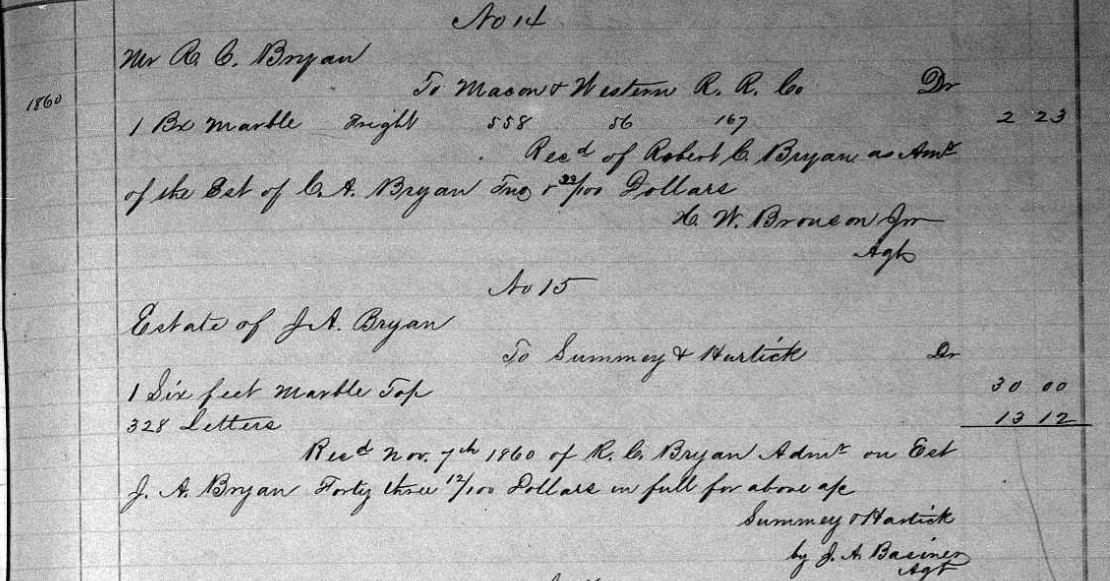
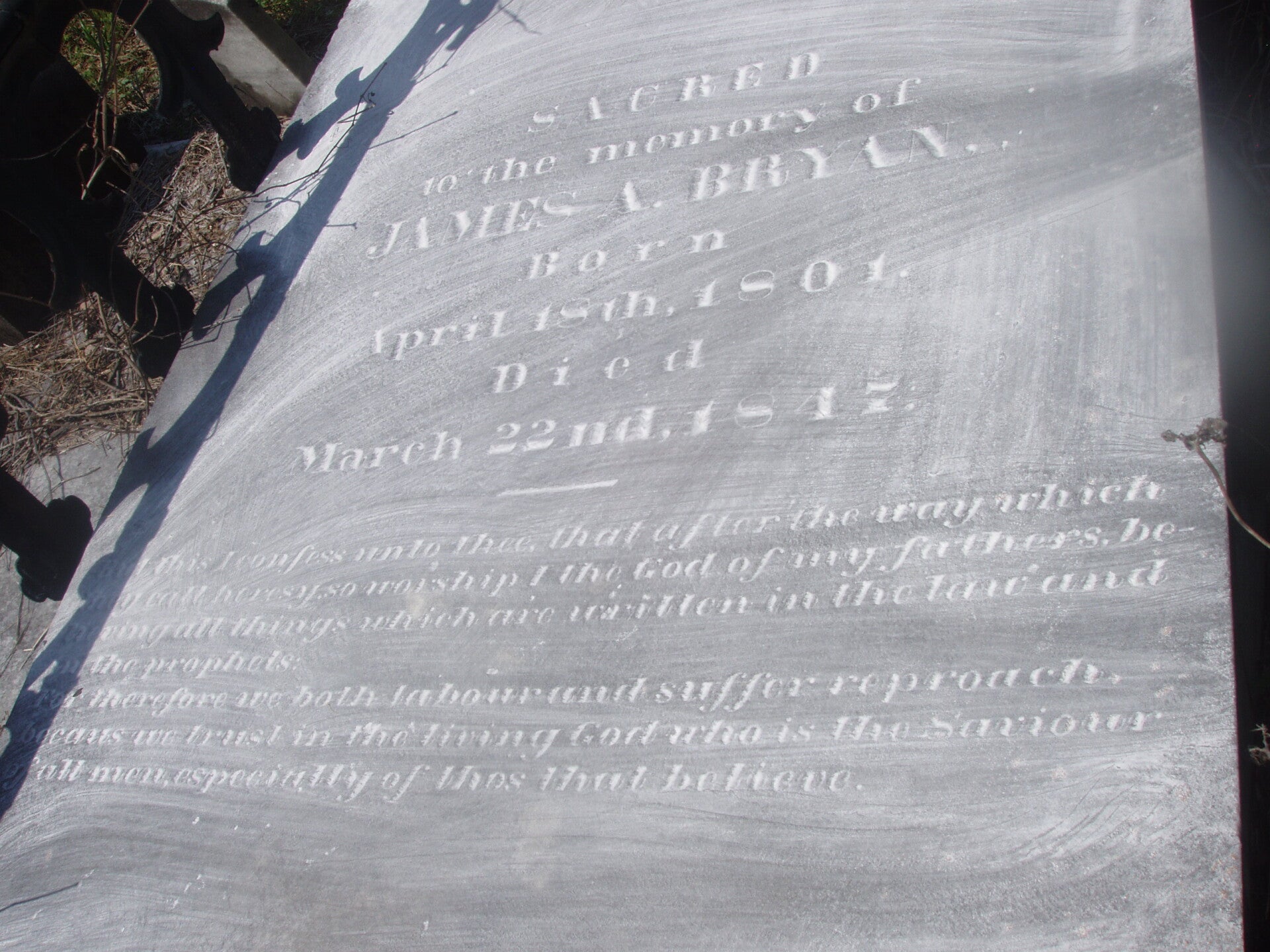
James A. Bryan died March 22, 1847. In 1849, Holmes supplied a marble marker for $149.40. In November 1860, thirteen years after his death, the estate commissions a permanent monument. Four separate transactions, four separate vendors. Summey & Warlick of Macon: one six-foot marble top with 328 carved letters — $43.12, paid November 7. The Macon & Western Railroad: freight on one box of marble, 558 pounds — $2.23, paid October 30. William L. Longley of Macon: 22 feet of iron railing and 4 granite blocks — $67.50, paid November 10. Nathan Weed of Savannah: iron bars for installation — $10.23, paid November 27. Total: $123.08.
The iron fittings came from Savannah by rail. The marble came from the stonecutters in Macon. The railing was cut to the length of the plot. A six-foot marble top with 328 letters is a substantial monument — the inscription includes birth and death dates, and two passages of scripture. The monument stands in the family cemetery on the property today. It marks the man whose estate generated every document in this record.
January 31, 1861: Harris & Ross sell 16 bales to E.A. Wilcox — 7,932 lbs at 10⅛ cents, $790.11 net. Georgia seceded twelve days before this sale. February 6: Tooke & Cooper at the Houston Factory takes 10 bales directly — $446.00. March 30: Adams & Reynolds sell 35 bales to John S. Hoye — 17,212 lbs at 10 cents, $1,677.45 net after storage and weighing. Total: 61 bales, $2,913.56.
The 35-bale March sale settles in Macon on March 30, 1861. Fort Sumter falls April 12. The cotton that was grown on the Sandbed Road, ginned, pressed, branded J.A.B., hauled across the Toby Sofky bridge to Cotton Avenue in Macon — was sold, or still in the warehouse, thirteen days before the first shots of the war. The ledger records the sale. It records the buyer's name. It does not record what happened next.
March 10, 1860: Negro Red for coal — $3.00. This is Redick, appraised at $800 in 1847 — the highest individual value in the inventory. He appeared first by name in March 1857 as Redick at the coal kiln. By 1860 the returns use the shortened name. The 1861 inventory lists him as Red at $1,000.
May 26, 1860: Negroes Bob and Jake hewing — $2.00. Bob was received into Sand Ridge Baptist Church in 1844, appraised at $300 in 1847. May 26, 1860 is his last confirmed appearance in the returns. Jake appears here for the first and only time in the entire record. Two men doing skilled timber work on the same day — one with sixteen years documented, one with a single entry.
October 28, 1860 and March 16, 1861: Charles for coal — $1.00, then $1.25. Charles is hired out annually through Cornelius with Claiborne and Matilda. He is also producing coal at the kiln independently. Two separate economic relationships in the same year, documented through two separate accounting channels.
Catharine P. Bryan is the most documented individual in the 1860 return. March 22: a berege robe, silk rep, fringe, and linen from J.N. Stein & Co. — $56.93. Two complete dress outfits with matching trim, in one Macon visit. Same day: drip caps from S.R. Audoin — $3.25, architectural trim for windows or doors on the house. April: a hat from Mrs. S. Audoin, $4.00. April 20: two hats at $6.00 each from M. Damour — $12.00. Two millinery visits in one April, $16 in hats.
August: Dr. F. Garke fills sixteen teeth — $40.00 plus brush and powder, $43.50 total. October: a cloth cloak and two pairs of gloves from Elias Einstein, $10.00. March 1861: a cameo pin from E.J. Johnston & Co., $8.00. Catharine P. Bryan is twenty-two years old in 1860. She is dressed for whatever that year brings. The ledger records every item.
The account current, between a postage entry in July and estate business expenses in September: Wiley Leverett May Party — $1.50. A social event called a May Party, organized or connected to Wiley Leverett, settled in August — the payment deferred from the event itself, which would have been in May. A May Party in the antebellum South was a seasonal outdoor celebration. The dollar fifty is the only record of it. Leverett's identity is not established in any document in the file. The party happened. The ledger paid for it.
J.N. Davis Sr. receives $2.00 for the Southern Literary Companion. He signs the receipt as "Ed. Lit. Comp." — he is the editor of the paper, published in Newnan, Georgia. Georgia seceded thirty-two days before this payment. The Bryan household renews its subscription to a literary newspaper while the state prepares for war. The same Davis family operates the Houston Factory — J.H. Davis & Son. The commercial and cultural worlds of the Bryan plantation run through the same local network: the mill that buys the cotton, the editor who publishes the paper, the commissioner who will certify the 1866 distribution.
The 1860 return closes with a balance in favor of the estate of $8,263.19 — the highest balance in the record's history, higher even than the $6,633.92 that opened 1860. Robert C. Bryan files the return on April 10, 1861. Fort Sumter falls April 12. The estate that James A. Bryan left with debts in 1847 is worth more in April 1861 than it has ever been. What the next four years will do to that balance — to the cotton market, to the plantation's labor, to the land itself — is not in this document. The 1860 return ends here. The 1861 return begins.
Enslaved People
Named and documented individuals appearing in the 1860 return. 🚩 marks a notable detail.
| Name | Date | What the record shows |
|---|---|---|
| Red | Mar 10, 1860 | Paid $3.00 for coal. First use of shortened name in the returns — previously Redick. In the 1847 inventory at $800, highest appraised value on the page. In the 1861 inventory as Red at $1,000. Coal work documented 1857–1860. 🚩 |
| Bob | May 26, 1860 | Paid $2.00 with Jake for hewing. Received into Sand Ridge Baptist Church 1844. In the 1847 inventory at $300. Last confirmed appearance in the estate returns. 🚩 |
| Jake | May 26, 1860 | Paid $2.00 with Bob for hewing — sole appearance in the entire record. No prior or subsequent entries. Working alongside Bob at skilled timber work on this single documented day. 🚩 |
| Charles | Oct 28, 1860 & Mar 16, 1861 | Paid $1.00 for coal (October) and $1.25 for coal (March 1861) — independently, separate from the annual hire arrangement. Also hired out through Cornelius with Claiborne and Matilda for the year. Two distinct economic relationships in the same return. 🚩 |
| Claiborne | Year 1860 | Hired out through Cornelius with Charles and Matilda — $600 for overseeing and hire, sixth consecutive year in this arrangement. |
| Matilda | Year 1860 | Hired out through Cornelius with Claiborne and Charles — sixth consecutive year. |
| Harvey | Jan 9, 1860 | Six days hired through J.R. King — $12.00. First appearance in the returns. Skilled labor through King's blacksmith operation. |
| B. Smith | Mar 9 & May 18, 1860 | 2.5 days each through J.R. King — $3.00 each = $6.00. Second confirmed year. Continues through at least 1864. |
| 33 unnamed | Oct 1860 | 33 pairs shoes from J.B. & W.A. Ross — fall distribution. Kersey for winter clothing in the same order. Annual provisioning consistent with prior years. |
Bryan Family
| Name | Role | What the record shows |
|---|---|---|
| Robert C. Bryan | Administrator / physician | 61-bale cotton year across three buyers. Commissions full marble monument for James A. Bryan's grave ($123.08). Purchases mule ($170), two sows and sixteen pigs ($25). Medical practice continues — W.H. Brown credited $10.50 toward the Heywood account as a named patient paying directly. Files return April 10, 1861. Balance forward $8,263.19 — highest in the record. |
| Cornelius Bryan | Overseer | $600 for overseeing and hire of Charles, Claiborne, and Matilda for year 1860 — paid February 29, 1861 (leap day). Sixth consecutive year at the same rate and with the same group. 🚩 |
| Catharine P. Bryan | Heir | Berege robe and silk rep outfit ($56.93); three hats across two April visits ($16); 16 dental fillings ($43.50); cloth cloak and gloves ($10); cameo pin ($8, March 1861). Most documented individual in the 1860 return. Age 22–23. 🚩 |
| Laura Bryan | Minor / student | Tuition from Mrs. P.A. Crowder — $20.00, January 15, 1861. Third consecutive year with the same teacher. Age 13–14. |
Businesses & Service Providers
| Name | What the record shows |
|---|---|
| Adams & Reynolds | 35 bales to John S. Hoye at 10 cents — $1,677.45 net, March 30, 1861. Largest single cotton transaction in the 1860 return. Settled thirteen days before Fort Sumter. 🚩 |
| Harris & Ross | 16 bales to E.A. Wilcox at 10⅛ cents — $790.11 net, January 31, 1861. All bale weights confirmed: 450–511 lbs each. Sold twelve days after Georgia's secession. |
| Houston Factory / Tooke & Cooper | 10 bales direct at 10 cents — $446.00, February 6, 1861. No broker fees on direct factory sales. Same enterprise cards the plantation's wool and buys its cotton. 🚩 |
| Summey & Warlick | Six-foot marble top with 328 carved letters — $43.12, November 7, 1860. Monument for James A. Bryan's grave. 🚩 |
| William L. Longley | 22 feet of iron railing and 4 granite blocks — $67.50, November 10, 1860. Monument component — railing cut to plot length. |
| Nathan Weed | Iron bars for monument installation — $10.23, November 27, 1860. Sourced from Savannah by rail. Monument component 4 of 4. |
| Macon & Western Railroad | Freight on one box of marble, 558 lbs — $2.23, October 30, 1860. Monument transport from Macon to the property. |
| J.B. & W.A. Ross | Two separate provisioning periods: fall 1860 (shoes, kerseys, coffee, sugar, blankets, hats, calico, flannel) and February 1861 settlement ($414.20 — 657 yards osnaburgs, molasses, homespun, shirting, salt, potatoes, castings, bagging). Full plantation provisioning across the year. 🚩 |
| Frederick W. Garke | 16 dental fillings at $2.50 each plus brush and powder — $43.50, August 1860. For Catharine P. Bryan. Largest single personal expenditure in the return. 🚩 |
| J.N. Stein & Co. | Berege robe, silk rep, fringe, cambric, linen — $56.93, March 22, 1860. For Catharine P. Bryan. Two complete dress outfits with trim in one Macon visit. |
| M. Damour | Two hats at $6.00 each — $12.00, April 20, 1860. For Catharine P. Bryan. Second millinery purchase in one April. |
| Elias Einstein | Cloth cloak $8.00 and two pairs gloves $2.00 — $10.00, October 18, 1860. For Catharine P. Bryan. |
| E.J. Johnston & Co. | Silver tea spoons — $8.00, March 22, 1860. Cameo pin — $8.00, March 11, 1861. Two jewelry purchases, one year apart. 🚩 |
| C.H. Heywood | Full-year medical account. Caustic holder, 170 grains caustic, cicuta extract, quinine, Darby's Fluid (twice), Stevens Eye Salve, chloroform, blister cerate. W.H. Brown credited $10.50 — named patient paying directly toward the account. 🚩 |
| Russell Hopson & Co. | Full running household account January–November 1860 — $55.48. Nails, shawl, curry combs, cotton cards, seeds, ribbon, brogans, hoes, boots, grain cradle, ginghams, calico, gaiters, lace, ladies boots. Perry store. |
| J.R. King | Hire of Harvey (6 days, $12.00) and B. Smith (5 days, $6.00) across 1860 — $18.00 total. Running blacksmith operation and brokering skilled labor continuously from at least 1859. |
| Solomon English | Cleaning and repairing two wells — $5.00, October 23, 1860. Water supply maintenance. Two wells confirmed on the property simultaneously. |
| J.N. Davis Sr. | Southern Literary Companion subscription — $2.00, February 20, 1861. Signs as "Ed. Lit. Comp." — the editor. Published in Newnan, Georgia. Davis family connected to Houston Factory and the 1866 estate distribution. 🚩 |
| H.W. Robb | One mule — $170.00, January 9, 1861. |
| Demcy Taylor | Two sows and sixteen pigs — $25.00, February 1, 1861. Livestock restocking for the new year. |
| Jefferson Tankersley for J.B. Wiley | Toby Sofky toll bridge — $8.00. Thirteenth consecutive year this crossing appears in the returns. Every bale of cotton in the record crossed here. 🚩 |
61 bales across three transactions — all sold after Georgia's secession, the last thirteen days before Fort Sumter. Total cotton income $2,913.56, confirmed to the cent across all three transactions.