1862 Return
19 documents · April 1, 1862 to April 1, 1863 · Houston County Court of Ordinary
Eight bales of cotton in April. One thousand bushels of corn to the Confederate government in March. That is the whole story in two lines.
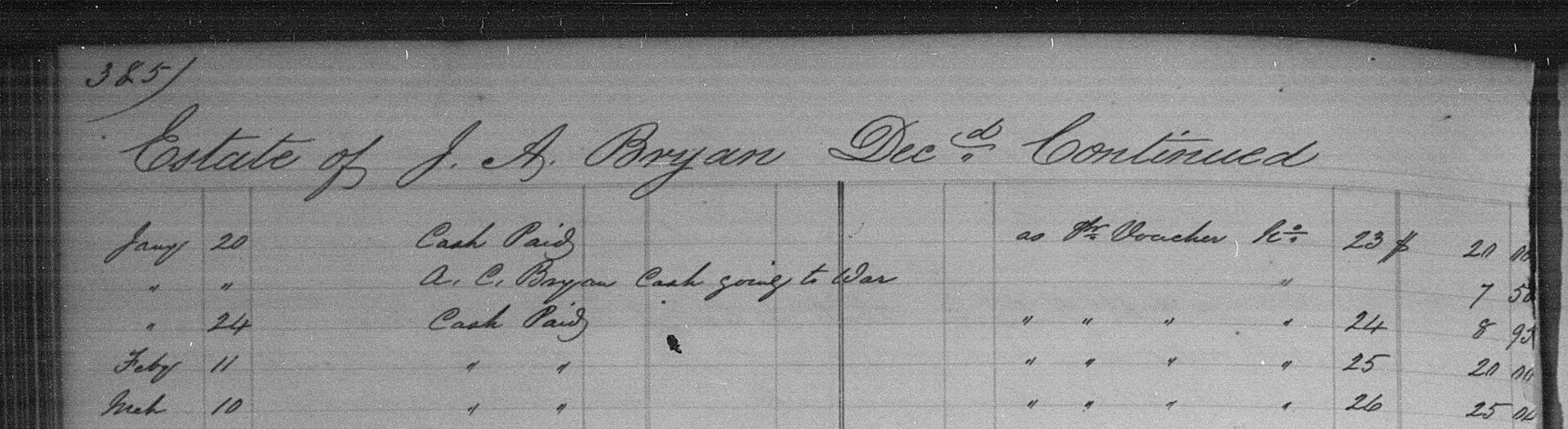
— 1862 Annual Return, Estate of James A. Bryan · April 25, 1862 and March 15, 1863The 1862 return is the year the plantation turned. Eight bales of cotton go to market in April — the last cotton sale in the war-era record. What follows across the next eleven months is a complete conversion of the plantation's commercial output: peanuts, ground peas, pinders, lard, corn — food crops sold to Macon merchants in five separate transactions, and then in March 1863, one thousand bushels of corn delivered directly to the Confederate government at $1.25 a bushel. Salt costs $25 a bushel by November. Shoes are made locally. Abner Bryan leaves for Confederate service on January 20, 1863 with $7.50 from the estate. The ledger records each of these facts in the same hand, at the same size, without distinction.
Adams & Reynolds sell eight bales of cotton to C. Wise — $310.50 net. The brand on the bales is J.A.B., the same mark that has been on every bale since 1847. This is the last cotton sale in the estate's war-era record. The plantation had sold 92 bales in 1858, 73 in 1859, 61 in 1860, 14 in 1861. It sells 8 in 1862, and after April 25 the cotton entries stop. What follows are peanuts and corn and ground peas and lard — the plantation's output measured in different units, sold through different buyers, at the prices a war economy sets.
Five food crop transactions across the fall and winter. McCallie & Jones in Macon: 116 bushels peanuts for $175.12, November 27; 97 bushels ground peas for $133.37, December 16 — signed for by Abner Bryan on the estate's behalf. Dunn & Burdick: 125 bushels ground peas for $188.65, then 13 bushels peas for $18.70, then 19 bushels for $26.95 across December and January. James W. Knott: 70½ bushels pinders for $105.07, December 23.
March 15, 1863: one thousand bushels of corn delivered directly to the Confederate government at $1.25 a bushel — $1,250 in a single transaction. The plantation that ran on cotton for thirty years sold food to the Confederate government in the thirty-first year. The ledger records the shift the same way it recorded everything else — date, commodity, amount, next entry.
B.G. Morris receives $100 for four bushels of salt — $25 per bushel. Before the war, salt was a routine line item — a few dollars for a substantial quantity at the same suppliers who sent bacon, rope, and bagging. By November 1862 four bushels cost $100, recorded without remark between a tax payment and a fabric purchase. Six weeks later, J.W. Fears & Co. supplies 342 lbs more salt for $188.10 — two large purchases in six weeks. In December, 700 lbs of pork are purchased for curing. The salt and the pork arrive in the same season. The smokehouse needs what it needs regardless of what it costs.
J.W.H. Murfee receives $30 for making thirty pairs of shoes — $1.00 per pair. In every prior year the plantation's annual shoe distribution came from Macon suppliers: Strong & Wood, Hopson Swift & Co., Joseph Drake & Son — purchased, shipped, distributed in October or November. In 1862 the shoes are made locally. The same number of people receive footwear. The supply line has changed. The leather purchased from Greer & Lake in December 1861 may be the raw material; Murfee is the craftsman. Thirty pairs, $30, the work done close to the plantation rather than ordered from the city.
Ben Stripling delivers two lumber orders in March: scantling, rafters, plank, weatherboards, roughedge boards — $30.28 total. An iron purchase follows in September: 360 lbs at 6 cents and 242 lbs at 3 cents from Carhart & Curd, $28.86. The lumber and the iron together point at a structure built on the property in the first year of the war. The receipts name the materials and the amounts. They do not name the structure.
The ledger: A.C. Bryan cash going to war — $7.50. Abner Bryan is twenty-six years old. The entry sits between a receipt for four empty barrels at $5 each and a fabric purchase from Asher Ayres. The estate had sold one thousand bushels of corn to the Confederate government the previous month for $1,250. It handed Abner $7.50. The ledger moved to the next line.
Enslaved People
Named and documented individuals appearing in the 1862 return. 🚩 marks a notable detail.
| Name | Date | What the record shows |
|---|---|---|
| Claiborne | Dec 28, 1862 | Hired out with Charles and Matilda for year 1861 — $300 total paid to Cornelius Bryan. Receipt signed by Cornelius. Horse collar receipts documented from 1852 through 1859. 🚩 |
| Charles | Dec 28, 1862 | Hired out with Claiborne and Matilda for year 1861 — $300 total. Also documented independently at the coal kiln in 1860 and 1861. |
| Matilda | Dec 28, 1862 | Hired out with Claiborne and Charles for year 1861 — $300 total. |
| B. Smith | Jan & May 1862 | Hired through J.R. King — 7.5 days January, 2.5 days May, $20 total. Fourth confirmed year. Day rate $2.00. |
| 30 unnamed | Nov 15, 1862 | 30 pairs shoes made locally by J.W.H. Murfee — $30.00. Annual fall distribution, first year sourced locally rather than purchased from Macon. 🚩 |
Bryan Family & Heirs
| Name | Role | What the record shows |
|---|---|---|
| Robert C. Bryan | Administrator / physician | Managing the plantation's full pivot from cotton to food crop production. Files return with W.T. Swift, Ordinary. Medical supplies from Heywood's continue across the year. Sells syrup to Heywood's pharmacy — credited against the medical account. |
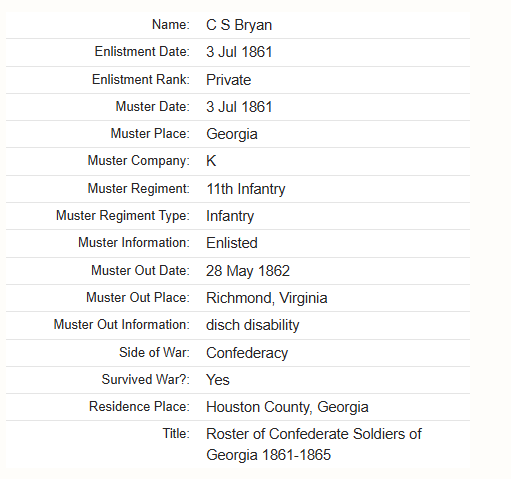
| Cornelius Bryan | Overseer | Enlisted July 3, 1861 — 11th Georgia Infantry, Company K, Private, Houston County. Discharged for disability May 28, 1862 at Richmond, Virginia. Paid $90 for overseeing year 1862, March 10, 1863. Also receives $717.75 distributive share from Catharine H. Bryan's estate. Signs receipt for hire of Claiborne, Charles, and Matilda — $300. 🚩 |
| Ira Hugh Bryan | Overseer / heir | Listed on 1861 Houston County Volunteers muster roll. Paid $90 for overseeing year 1862, March 10, 1863. Also receives $717.75 distributive share from Catharine H. Bryan's estate. 🚩 |
| James S. Bryan | Overseer / heir | Paid $50 for overseeing year 1861, December 13, 1862. Second consecutive year as overseer. |
| Abner Bryan | Heir / soldier | Signs receipt for 97 bushels ground peas sold to McCallie & Jones on behalf of the estate, December 16, 1862. Cash going to war — $7.50, January 20, 1863. 🚩 |
| Laura Bryan | Minor / student | Board and tuition at W.M. Whitehurst's home in Gordon — $75 paid September 5, 1862. Additional $25 paid March 10, 1863. Age 15–16. |
| Troup Bryan (estate) | Deceased | D.B. McDonald, administrator of Troup's estate, receives three distributive payments from Catharine H. Bryan's estate on behalf of Troup's widow Frances E. Bryan — April, June, and September 1862. Total approximately $300. 🚩 |
| W.M. Whitehurst | Brother-in-law | Receives $611 plus $133.12 in distributive shares from Catharine H. Bryan's estate — husband of Nancy Bryan. Also receives payment for Laura's board and tuition in Gordon. |
Businesses & Service Providers
| Name | What the record shows |
|---|---|
| Adams & Reynolds | 8 bales cotton to C. Wise — $310.50, April 25, 1862. Last cotton sale in the war-era record. 🚩 |
| Confederate Government | 1,000 bushels corn at $1.25 per bushel — $1,250.00, March 15, 1863. Direct sale, no broker. Largest single transaction in the 1862 return. 🚩 |
| McCallie & Jones | Two food crop purchases — 116 bushels peanuts $175.12 (November 27) and 97 bushels ground peas $133.37 (December 16, signed by Abner Bryan). Macon food buyers, new to the estate record. |
| Dunn & Burdick | Three ground pea purchases — 125 bushels $188.65, 13 bushels $18.70, 19 bushels $26.95, December 1862 through January 1863. Second Macon food buyer, new to the record. |
| James W. Knott | 70½ bushels pinders — $105.07, December 23, 1862. Individual buyer. |
| B.G. Morris | 4 bushels salt — $100.00, November 3, 1862. $25 per bushel. 🚩 |
| J.W. Fears & Co. | 342 lbs salt — $188.10, December 2, 1862. Second salt purchase six weeks after Morris. Also 1 bunch cotton $6.50. |
| J.W.H. Murfee | 30 pairs shoes made locally — $30.00, November 15, 1862. First year shoes sourced locally rather than purchased in Macon. 🚩 |
| Ben Stripling | Two lumber orders — scantling, rafters, plank, weatherboards, roughedge boards — $30.28 total, March 16 and 28, 1862. Also three pairs shoes $15, August 19. 🚩 |
| Carhart & Curd | 602 lbs bar iron in two grades — $28.86, September 25, 1862. Hardware purchase following the Stripling lumber orders. |
| Ross & Seymour | 273½ yards cotton osnaburgs at 25 cents — $68.37, May 13, 1862. Continuing plantation cloth supply under the Ross name. |
| Tooke & Cooper | 21 planks — $4.46, December 25, 1862. Lumber from the Houston Factory mill. Continuing commercial relationship. |
| C.H. Heywood | Medical supplies across the year — blister cerate, iodine, sarsaparilla, olive oil, red lead, ipecac, lobelia seed, iron tincture. Robert credits the account with plantation syrup — $18.27. 🚩 |
| J.R. King | Hire of B. Smith — 10 days across January and May 1862, $20.00. Fourth consecutive year. |
| A.T. Ingalls T.C. | State tax $62.95, county tax $66.89 — total $129.84, November 1862. Confederate state and county taxes. Significantly higher than pre-war years. |
| W.T. Swift | Ordinary of Houston County — recording return and distribution, $9.40, December 20, 1862. Confederate state court officer. |
| Newcomb & Patterson | Four empty barrels at $5 each — $20.00, January 20, 1863. Same date Abner leaves for war. Barrels for storing or transporting the plantation's food crop production. |