1863 Return
18 documents · April 1, 1863 to April 1, 1864 · Houston County Court of Ordinary · Filed May 16, 1864
Confederate tax $1,125.84. Soldiers tax $151.50. State tax $103.02. Potato tithe $23.00. Income tax $39.60. Cattle tax $11.50. Six separate tax receipts. One fiscal year.
— 1863 Annual Return, Estate of James A. Bryan · October 1863 – January 1864The 1863 return is the most taxed year in the record. Six separate Confederate and state levies total $1,454.46 — more than the estate paid in taxes across the entire pre-war period. Cotton comes back: 22 bales at 35 cents a pound return $3,972 in two sales. The food crop economy continues alongside it — corn, peas, pindars, lard, wheat. Salt costs $25 a bushel in June, then $75 a pound by March 1864. A mule sells for $850. Sole leather costs $10 a pound. Cornelius Bryan is jailed in April, exempted as plantation overseer in July for $500, and receives hire payments in December. Laura Bryan and Honora Bryan have their teeth filled in Perry. The balance closes at $6,491.25 — held largely in Confederate bonds.
Knott & Hollingsworth buy 8 bales on October 3 — 4,167 lbs at 35 cents per pound, $1,458.45. They buy 14 more on December 9 — 7,149 lbs at 35 cents, $2,514.15. Twenty-two bales total, $3,972.60. The last pre-war cotton price in the record was 10 cents in 1861. The price in 1863 is 35 cents — three and a half times higher. The Confederate dollar behind that 35 cents is not the same as the pre-war dollar. The estate records the nominal figures. The real value is a different calculation.
The brand on the bales is J.A.B. and R.J.B. — two brands on the December sale, suggesting cotton from two different sources or two different crops pressed together. The estate has been running food crops since 1862. The cotton that went to market in 1863 was grown and ginned alongside pindars and corn and stock peas.
1,600 bushels of corn at $2.10 per bushel — $3,360.00 in a single transaction. The same crop sold to the Confederate government in March 1863 at $1.25 a bushel. In nine months the corn price has risen from $1.25 to $2.10. The plantation produced and sold food at whatever the market set, to whatever buyer would pay it. The ledger records the bushels and the price. It does not record who needed the corn or what became of it.
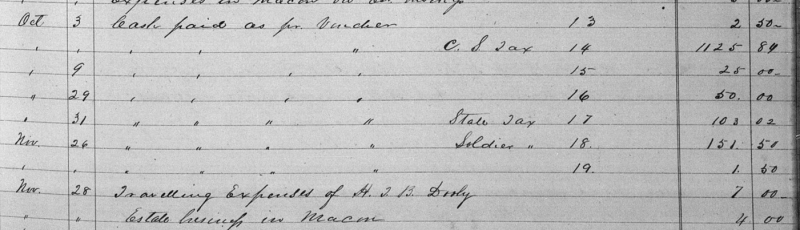
Six separate tax receipts across October through January. Confederate tax — $1,125.84, paid October 3 to J.W. Mann, District Collector. State tax — $103.02, paid October 31 to A.F. Ingalls, Tax Collector. Soldiers tax — $151.50, paid November 26 to E.E. Davis, Collector. Potato tithe commutation — $23.00, paid January 23 to James A. Pringle, Agent Depot No. 8. Income tax — $39.60, paid January 23 to J.W. Mann. Cattle tax — $11.50, paid January 23.
Total: $1,454.46. The estate paid more in taxes in this single year than in all pre-war years combined. Each receipt names a different collector, a different tax category, a different authority. The plantation at Wilna is being taxed by a government fighting a war.
S.J. Fordham, Jailor, receives $4.05: taking charge and putting in jail, $1.80; taking out, $.90; dieting 3 days, $1.35. Cornelius Bryan is in the Macon jail for three days in April 1863. The charge is not stated. The release is not explained. The $4.05 is paid by the estate and recorded as Voucher 1. Three months later, the estate pays $500 to the Confederate Quartermaster to exempt Cornelius as plantation overseer.
Quarter Master's Department, Macon, Georgia, July 28, 1863. Received of R.C. Bryan, Administrator of the Estate of James A. Bryan, five hundred dollars to exempt C.P. Bryan as overseer on said estate. Signed: J.M. Moore, Captain and A.Q.M. The Confederate government required plantations employing twenty or more enslaved people to have a white male overseer exempt from military service — the so-called Twenty Negro Law. The estate pays $500 to maintain Cornelius in the overseer role. The plantation needs a manager. The price is $500.
June 10, 1863: Ira Hugh Bryan signs for eight sacks of salt — $200.00. Twenty-five dollars a sack. March 1, 1864: Asher Ayres receives $450 for two barrels of salt, 600 lbs total — 75 cents per pound. The estate paid roughly two dollars for a full sack of salt before the war. In June 1863 it pays $25. By March 1864 it pays $450 for 600 lbs. The same commodity, the same use — curing meat, preserving food — at prices that mark a supply chain under severe strain.
L.D. Carpenter, Dentist, Perry, Georgia, February 1864: 19 gold fillings, extracting and other work for Laura Bryan — $450.00. Five gold fillings for Honora Bryan — $100.00. Total: $550.00. Two Bryan sisters in the dentist's chair in Perry in February 1864. Gold fillings at wartime prices — the dental work that would have cost a fraction of this before the blockade now costs $550 for two patients. The estate pays it. L.D. Carpenter signs the receipt. The ledger moves to the next entry.
Two leather purchases document the supply chain's state. Roberts, Dunlap & Co. in Macon: 27½ lbs sole leather at $10 per pound — $275.00, December 17. Joseph Tooke dresses nineteen sides of leather — $38.00, January 1, 1864. The plantation is processing its own hides through Tooke's operation and buying finished sole leather from Macon at wartime prices. Before the war, shoes were purchased ready-made from Macon suppliers for $1.00 to $1.50 a pair. The raw material now costs $275 for enough leather to sole a season's worth of footwear.
Enslaved People
Named and documented individuals appearing in the 1863 return. 🚩 marks a notable detail.
| Name | Date | What the record shows |
|---|---|---|
| Claiborne, Charles, Matilda | Dec 22, 1863 | Hire of three negroes for year 1862 — $300 total, paid to Cornelius Bryan. Seventh consecutive year this group appears in the hire arrangement. 🚩 |
| Hire at Savannah | Year 1863 | Hire of negro at Savannah fortifications — $35.00. One person, unnamed, hired to Confederate military works at Savannah. No further detail in the record. 🚩 |
| Hire — year 1863 | Mar 10, 1864 | Hire of negroes for year 1863 — $150.00, paid to Cornelius Bryan. Three people, unnamed in this receipt. Reduced from $300 in prior years. |
| 40 lbs cotton carded | Jan 23, 1864 | Houston Factory cards 40 lbs cotton at 40 cents — $16.00. Cotton now being carded alongside wool — the plantation processing its own fiber for cloth production. 🚩 |
| 4 pairs shoes | Dec 18, 1863 | Four pairs shoes — $10.00, from Thos. R. Pates. Scale of shoe distribution reduced from 30–38 pairs in prior years to 4 pairs documented here. Leather scarcity reshaping the annual distribution. 🚩 |
Bryan Family & Heirs
| Name | Role | What the record shows |
|---|---|---|
| Robert C. Bryan | Administrator / physician | Managing 22-bale cotton year alongside full food crop production. Pays six separate tax receipts totaling $1,454.46. Purchases cotton cards personally ($30) and charges to estate. Medical supplies from Heywood's continuing. Files return May 16, 1864. |
| Cornelius Bryan | Overseer | In Macon jail April 8–10 — $4.05 fees paid by estate. Exempted as plantation overseer July 28 — $500 paid to Confederate Quartermaster. Receives $300 for hire of three negroes for year 1862, December 22. Receives $150 for hire of negroes for year 1863, March 10, 1864. Also signs receipt for cow hides $38, September 19. 🚩 |
| Ira Hugh Bryan | Heir | Signs for eight sacks salt — $200.00, June 10, on behalf of the estate. Signs for five cow hides — $38.00, September 19. Two documented estate transactions this year. 🚩 |
| Catharine P. Bryan | Heir | Sundries purchased in Macon on her behalf by Abner Bryan — $20.00, July 26. Also purchases Macon sheeting on behalf of the estate — $10.00, August 27. Active in estate business in Macon. |
| Abner Bryan | Heir / soldier | Purchases sundries in Macon for Catharine P. Bryan — $20.00, signed and receipted July 26. Last documented appearance before the war years close. 🚩 |
| Laura Bryan | Minor / student | Spring and fall terms at W.H. Allen's school — tuition, music lessons, piece music (Favorite Waltz, Bonny Eloise), use of instrument. Spring $59.55, fall $58.50. Board with J.H. Moreland for last term, 4 months — $105.00. Board with E.H. Wimberly 5 months — $80.00. 19 gold fillings and dental work — $450.00, L.D. Carpenter, Perry, February 1864. Travels to Wilkinson County, March 1864 — $10.00 expenses. 🚩 |
| Honora Bryan | Heir / student | 5 gold fillings — $100.00, L.D. Carpenter, Perry, February 1864. Dental work alongside Laura at the same appointment. Traveling expenses with H.J.B. Darby, educator, November 28 — $7.00. 🚩 |
Businesses & Service Providers
| Name | What the record shows |
|---|---|
| Knott & Hollingsworth | 22 bales cotton — 8 bales October 3 ($1,458.45) and 14 bales December 9 ($2,514.15). Both at 35¢ per pound. Total $3,972.60. Returning as buyer after appearing in the 1856 return. 🚩 |
| J.W. Mann | Confederate tax collector, District 35 — $1,125.84 (October 3) and $39.60 income tax (January 23). Two separate Confederate levies collected by the same officer. 🚩 |
| A.F. Ingalls T.C. | State tax — $103.02, October 31. |
| E.E. Davis | Soldiers tax collector — $151.50, November 26. |
| James A. Pringle | Agent Depot No. 8 — potato tithe commutation $23.00, January 23, 1864. |
| J.M. Moore Capt. & A.Q.M. | Confederate Quartermaster — receives $500 for exemption of Cornelius Bryan as plantation overseer, July 28, 1863. 🚩 |
| Asher Ayres | Two barrels salt, 600 lbs at 75¢ per lb — $450.00, March 1, 1864. Salt price has risen from $25 per sack in June 1863 to $75 per pound by March 1864. 🚩 |
| Roberts, Dunlap & Co. | 27½ lbs sole leather at $10 per lb — $275.00, December 17, 1863. Macon leather supplier at wartime prices. Also wool cards $20, September 28. 🚩 |
| L.D. Carpenter | Dentist, Perry — 19 gold fillings and work for Laura Bryan $450; 5 gold fillings for Honora Bryan $100. Total $550.00, February 1864. 🚩 |
| W.H. Allen | School — spring and fall terms for Laura Bryan. Tuition, music lessons (Favorite Waltz, Bonny Eloise), use of instrument. Spring $59.55, fall $58.50. |
| J.H. Moreland | Board for Laura Bryan — 4 months last term, $25 per month plus paper, shoe work, postage stamps = $105.00, December 23. |
| E.H. Wimberly | Board for Laura Bryan — 5 months at $16 per month = $80.00, March 24, 1864. |
| Houston Factory — A.M. Crowder | Carding 40 lbs cotton at 40¢ — $16.00, January 23, 1864. Cotton now carded at the factory alongside wool. Continuing commercial relationship across the full record. 🚩 |
| Jno R. Fleig | Blacksmith hire — 14 days across January, May, and November 1863, $32.25. Also three rollers with irons and cogs — $20.00. Total $52.25, February 1, 1864. New blacksmith in the record replacing King's operation. |
| Joseph Tooke | Dressing nineteen sides of leather — $38.00, January 1, 1864. Plantation hides processed locally. Also 21 plank — $4.46. Mill and leather operation continuing. |
| M.H. Taylor | One mule — $850.00, February 17, 1864. Highest mule price in the record. Pre-war mules cost $130–$200. 🚩 |
| S.J. Fordham | Jailor — $4.05 for taking charge, dieting 3 days, and releasing Cornelius Bryan, April 8, 1863. 🚩 |
| A. Bedingfield & Co. | One bunch No. 12 yarn $23 (September 29); 20 bushels oats $60, 5 bushels rye $50 — $110.00 (December 9). Two separate transactions. |
| J.W. Fears | One bunch No. 10 cotton yarn — $25.00, October 9. Yarn being purchased for cloth production as Macon supply chains tighten. |
| Strong & Howes | One pair cotton cards — $50.00, October 29. Wartime price for a tool that cost $1–2 before the war. 🚩 |
| B. Stripling & Co. | Dressing two hides and goat skins — $1.50, November 25. Same Stripling who supplied lumber in 1862, now processing hides. |
| R.T. Arant | Cropping turnpike for the current year — $20.00, February 3, 1864. Road maintenance payment — the Tobesofkee crossing continuing to require upkeep. |
| S. Rose & Co. | Advertising for sale of negroes — $8.50, settled July 24, 1863. Two advertisements: leave to sell (September 26, 1861, 60 days, $5.00) and sale of negroes (November 27, 1861, 40 days, $3.50). 🚩 |
22 bales at 35¢ per pound — $3,972.60 total. The nominal price is three and a half times the pre-war rate. The Confederate dollar purchasing that cotton is not the pre-war dollar. The balance at year's end is held largely in Confederate 4% bonds.