1864 Return
9 documents · April 1, 1864 to April 1, 1865 · Houston County Court of Ordinary · Filed May 1, 1865
Sherman's officers made their headquarters at Nancy's plantation in Gordon and left it desolate when the columns moved on. The estate ledger records the travel expenses of three sisters making the journey to Wilkinson — $20 each. It does not record what they found.
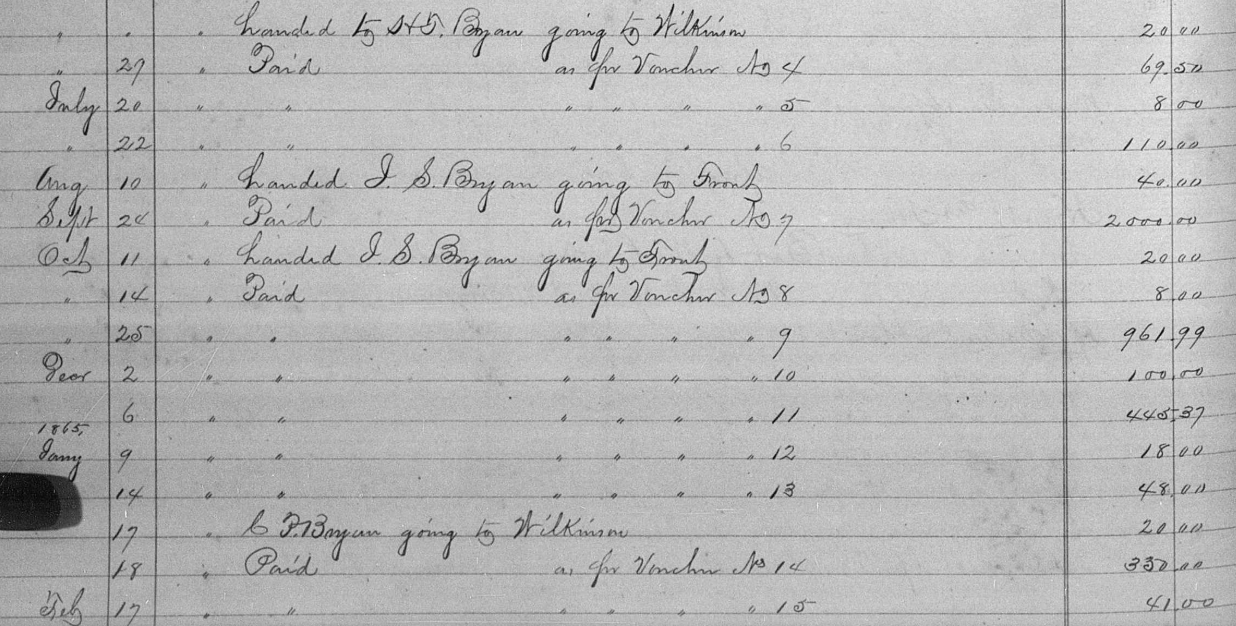
— 1864 Annual Return, Estate of James A. Bryan · Account Current, June 1864 – February 1865The 1864 return is the last full year of the war, and the ledger carries it the same way it has carried every year: dates, amounts, names, next entry. Nine documents — the fewest since the estate's first return in 1847. James S. Bryan is handed money going to the Front in August and again in October. In November, Sherman's right flank passes through Wilkinson County. Nancy Bryan Whitehurst's plantation in Gordon lies on the army's path. The estate records show Honora traveling to Wilkinson in June — before — and Catharine P. and Laura traveling there in January and February — after. A syrup mill is purchased for $2,000. Twenty-six bales of cotton go to market. Cornelius Bryan receives his final settlement. The return is filed May 1, 1865 — three weeks after the war ends. The balance is $18,591.62, held in Confederate instruments and individual notes.
Knott & Hollingsworth buy 16 bales on April 21, 1864 — two lots at different rates. Two bales branded R.C.B. sell at 35 cents per pound, $327.25. Fourteen more at 45 cents, $3,050.55. Total first sale: $3,381.80. Knott & Hawes buy 10 bales on March 4, 1865 — 5,203 lbs at 80 cents per pound, $4,162.40.
The April sale at 45 cents and the March sale at 80 cents document the price trajectory of wartime cotton across ten months. The second sale is made after Fort Sumter has fallen and before the war formally ends — the cotton that crossed the Toby Sofky bridge in early 1865 sold at the highest per-pound price in the estate's entire record.
James W. Knott — the same buyer who purchased pindars in 1862 — receives $2,000 for one syrup mill. It is the largest single purchase in the war-era record, and the largest non-enslaved-person purchase in the entire estate. A syrup mill processes sorghum or sugar cane into molasses and syrup. The plantation has been producing food crops since 1862 — peas, pindars, corn, lard. A syrup mill in September 1864 is production infrastructure for the food economy the plantation has been building across three years of war. The estate that paid $1.80 for a box of chrome green paint in 1859 pays $2,000 for this.
August 10: cash handed J.S. Bryan going to Front — $40.00. October 11: cash handed J.S. Bryan going to Front — $20.00. James S. Bryan is documented in the estate returns as a student, then a boarder, then an overseer. The ledger records him going to the Front twice in 1864 with money from the estate — $40 in August, $20 in October. The two entries are the full extent of what the documents record about his military service.
Catharine H. Bryan died May 1861. Her estate — dower land, a cotton crop, individual interests — is being distributed among her heirs across 1864 and into 1865. Ira Hugh Bryan receives $954.60 as his full distributive share: one-tenth of one-eighth of 65 bales of cotton, $414.60, plus $540 for lands, March 4, 1865. Cornelius Bryan receives $1,903.20 for his own and W.M. Whitehurst's share — one-tenth of one-sixth — covering mother's dower and her interest in 65 bales of cotton, March 28, 1865. The distribution of one estate running through the administration of another, three and a half years after her death.
Cornelius Bryan receives $350.00 in full payment of all demands for overseeing and negro hire up to this date — January 18, 1865. A single receipt closing out the overseer arrangement that has been running since 1856. Nine years of overseeing and hire of Claiborne, Charles, and Matilda, settled in one final payment. The receipt is signed by Cornelius. The arrangement ends here.
In February 1853, the estate paid Samuel Griswold $48.50 to overhaul the plantation's 50-saw cotton gin — filing all fifty saws, fitting a new main shaft, fifty-one new ribs, a new cotton box. Griswold came to the plantation to do the work. His factory was four miles east of Macon at Griswoldville, where he made and repaired cotton gins for customers across the county. When the war came, Confederate pistols were made at Griswoldville.
On November 20, 1864, Sherman's right flank came through Griswoldville and burned what was there — the depot, the factory works, everything. Two days later, Georgia militia marched into Union artillery near the ruins. A Union soldier who was there wrote about it that night. His brigade of eleven hundred had faced about six thousand men. The Confederates came out of the pine timber in three lines. Old grey-haired and weakly looking men and little boys, not over fifteen years old, lay dead or writhing in pain. Confederate losses: a thousand. Union losses: fourteen. The gin repairman's factory was ash.
— Lynton: A History of the 1832 Bryan Plantation House, Chapter Six.
Three separate entries record Bryan family members traveling to Wilkinson County. June 16, 1864: cash handed to Honora Bryan going to Wilkinson — $20.00. January 17, 1865: cash handed to Catharine P. Bryan going to Wilkinson — $20.00. February 18, 1865: cash handed to Laura A. Bryan for Wilkinson — $20.00. Nancy Bryan Whitehurst lives in Gordon, Wilkinson County, where her husband W.M. Whitehurst was away with the State Guard cavalry.
In November 1864, between Honora's June trip and Catharine P.'s January trip, Sherman's right flank moved through Wilkinson County on its march toward Savannah. Nancy's plantation in Gordon lay on the army's path. Sherman's officers made their headquarters there. When the columns moved on, the plantation was left desolate. The estate records show two of Nancy's sisters traveling to Gordon in the months that follow. The ledger records the travel expenses. It does not record what they found when they arrived.
Enslaved People
Named and documented individuals appearing in the 1864 return. 🚩 marks a notable detail.
| Name | Date | What the record shows |
|---|---|---|
| Claiborne, Charles, Matilda | Jan 18, 1865 | Final settlement of all overseeing and negro hire — $350.00 to Cornelius Bryan, January 18, 1865. Nine years of this arrangement documented in the returns, 1856–1865. 🚩 |
| B. Smith | Mar–Jan 1864–65 | Hired through J.R. King — 2 days March 26 at $2.50, 1 day May 1 at $3.00, 6 days January 6, 1865 at $5.50. Total $41.00. Day rate rising from $2.00 in 1862 to $5.50 by January 1865. Sixth confirmed year. 🚩 |
| 80 lbs cotton carded | Jan 1865 | Kinston Factory & Co cards 55 lbs cotton at 60¢ ($33.00) and 25 lbs at 60¢ ($15.00) — $48.00 total. Houston Factory carding wool; Kinston Factory now carding cotton. Two mill operations serving the plantation simultaneously. 🚩 |
Bryan Family & Heirs
| Name | Role | What the record shows |
|---|---|---|
| Robert C. Bryan | Administrator / physician | 26-bale cotton year across two sales. Purchases syrup mill $2,000. Manages distribution of Catharine H. Bryan's estate to multiple heirs. Files return May 1, 1865 before E. Jackson, Clerk of the Inferior Court. Balance forward $18,591.62 held in Confederate instruments and individual notes. |
| Cornelius Bryan | Overseer | Receives $150 for negro hire for 1863, June 16, 1864. Receives $350 in full settlement of all overseeing and negro hire to date, January 18, 1865. Also receives $1,903.20 covering his own and W.M. Whitehurst's share of Catharine H. Bryan's estate — dower and interest in 65 bales cotton, March 28, 1865. 🚩 |
| Ira Hugh Bryan | Heir | Receives $954.60 as full distributive share of Catharine H. Bryan's estate — one-tenth of one-eighth of 65 bales cotton ($414.60) plus lands ($540), March 4, 1865. 🚩 |
| James S. Bryan | Heir / soldier | Cash handed going to Front — $40.00 August 10, $20.00 October 11. Also receives $25.00, February 29. Two documented departures toward Confederate service. 🚩 |
| Honora Bryan | Heir / student | Cash handed going to Wilkinson — $20.00, June 16. Tuition at Miss M.A. Birch's school — $110 for 3 months, July 22. Fall term tuition — $100, December 2 (H. Taylor). 🚩 |
| Catharine P. Bryan | Heir | Cash handed going to Wilkinson — $20.00, January 17, 1865. Purchases Macon sheeting on estate business — $10.00 noted in prior return, continuing role in Macon transactions. |
| Laura Bryan | Minor / student | Cash for Wilkinson — $20.00, February 18, 1865. Two pairs ladies shoes made — $8.00, July 20. Tuition at Miss M.A. Birch's school — $110 for 3 months, July 22. Fall term — $100. Three sisters traveling to Wilkinson within eight months. |
| Nancy Bryan Whitehurst | Heir | Her husband W.M. Whitehurst's share of Catharine H. Bryan's estate received by Cornelius Bryan — included in the $1,903.20 settlement, March 28, 1865. Three of her sisters travel to Gordon, Wilkinson County across this fiscal year. |
Businesses & Service Providers
| Name | What the record shows |
|---|---|
| Knott & Hollingsworth | 16 bales cotton — 2 at 35¢ ($327.25) and 14 at 45¢ ($3,050.55) — total $3,381.80, April 21, 1864. Same buyer as the 1863 cotton sales. 🚩 |
| Knott & Hawes | 10 bales cotton at 80¢ per pound — $4,162.40, March 4, 1865. Highest per-pound price in the estate record. 🚩 |
| James W. Knott | One syrup mill — $2,000.00, September 24, 1864. Largest single non-enslaved-person purchase in the estate record. 🚩 |
| Harris & Pence | 139 lbs salt at 50¢ per lb — $69.50, June 29, 1864. Salt price down from $75/lb in March 1864 to 50¢ by June. |
| Miss M.A. Birch | Tuition for Laura Bryan and Honora Bryan — $110 for 3 months, July 22, 1864. New teacher in the record. |
| H. Taylor | Tuition for Laura Bryan, fall term — $100.00, December 2, 1864. |
| Thomas R. Gates | Two pairs ladies shoes — $8.00, July 20, 1864. Three pairs shoes — $18.00, January 9, 1865. Shoemaker continuing to supply the plantation locally. |
| Kinston Factory & Co. | Carding 80 lbs cotton — $48.00, January 1865. New mill operation in the record. Cotton being carded for cloth production alongside wool at Houston Factory. 🚩 |
| Houston Factory — A.M. Crowder | $48.00 received January 14, 1865 — continuing carding relationship. Fourteenth year the Houston Factory appears in the returns. 🚩 |
| J.R. King | Hire of B. Smith — $41.00 across March 1864 and January 1865. Day rate rising: $2.50 in March, $3.00 in May, $5.50 in January 1865. Seventh consecutive year. |
| Jas B. McMurray | Soldiers tax — $445.37, December 6, 1864. 🚩 |
| John S. Gober | Soldiers tax — $410.80, March 11, 1865. Two soldiers tax receipts in one fiscal year. 🚩 |
| E.R. Lewis T.C. | State and county tax — $96.99, 1864. |
| S. Rose & Co. | Advertising sale of dower land of Catharine H. Bryan — $8.00, October 11, 1864. Georgia Journal and Messenger, 40 days. |
| M.C. Rousseau | One bunch cotton yarns — $50.00, May 20, 1864. Yarn for cloth production. |
| R.T. Arant | Cropping turnpike — $20.00, February 3, 1864. Tobesofkee crossing maintenance continuing. |
| Eli Warren | Writing returns — $10.00, April 15, 1864. The estate's annual returns are now being drafted by a hired hand rather than in Robert's own hand. |
26 bales across two sales — $7,544.20 total. The March 1865 sale at 80¢ per pound is the highest per-pound price recorded in the estate's entire history.