1865 Return
25 documents · April 1, 1865 to April 1, 1866 · Houston County Court of Ordinary · Filed April 30, 1866
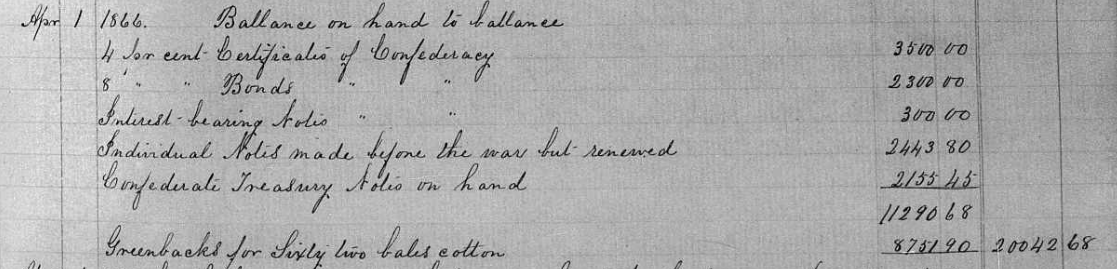
62 bales cotton. March 26, 1866. 32,047 lbs at 28 cents. $8,751.90 net. Greenbacks.
— 1865 Annual Return, Estate of James A. Bryan · Harris & Ross, Account Sales No. 2The war ended April 9, 1865. The 1865 return opens April 1. The plantation at Wilna moves through the first year of peace the same way it moved through the war years — methodically, with work to do. Four bales of cotton sell in September for greenbacks at 24 cents a pound. Sixty-two bales sell the following March at 28 cents. The Planters' Association supplies calico and homespun. Abner Bryan does blacksmithing for the estate. Honora Bryan does mending. Laura Bryan continues in school. The Confederate bonds, certificates, and treasury notes sit on the books alongside individual notes and United States currency. The estate is filed April 30, 1866. The following day, the Final Distribution is signed.
Knott & Howel buy 4 bales on September 7, 1865 — 2,038 lbs at 24 cents, $488.12 net in greenbacks. The receipt specifies the currency. In March 1866, Harris & Ross sell 62 bales to E.A. Wilcox — 32,047 lbs at 28 cents, $8,751.90 net after storage, stamps, and commissions. The brand on every bale is J.A.B. — the same mark that has been on Bryan estate cotton since 1847. Sixty-two bales is the largest single cotton transaction in the estate record. The plantation that sold 8 bales in its last war-year now sells 62 in a single March day.
The balance forward from the 1864 return — $10,802.56 — is held in the following instruments: Confederate 4% certificates, $3,500. Confederate 8% bonds, $2,300. Confederate interest-bearing notes, $300. Individual notes made before the war but renewed, $2,443.80. Confederate treasury notes on hand, $2,155.45. Total Confederate instruments: $10,799.25. Plus greenbacks received for the September cotton sale. The estate holds what it holds. The ledger records each instrument by name and amount. The return is sworn before W.T. Swift, Ordinary of Houston County, April 30, 1866.
Cash handed to Honora Bryan going to Wilkinson — $30.00. The war has been over for less than a month. Nancy's plantation in Gordon was left desolate when Sherman's columns moved on in November 1864. Honora makes the trip in May 1865 with $30 from the estate. The ledger records the amount. What she found in Gordon is not in this document.
Two receipts signed on the same December day. Abner C. Bryan receives $10.00 for blacksmithing done for the estate. Honora Bryan receives $10.00 for mending done for the estate. Both are paid from the estate account. Abner went to war with $7.50 in January 1863. He is home and working the forge. Honora is mending. The estate pays them both for their labor, the same way it has always paid for work done on its behalf. The ledger records it and moves to the next entry.
Two purchases from the Planters' Association through agent W.A. Hopson. October 21: 20 yards calico and 12 yards bleached homespun — $15.50. December 8: calico, poplin, cambric, bleached cotton remnants, Irish linen, handkerchiefs, scissors, thread, needles — $24.55. The Planters' Association is a new name in the returns — a post-war cooperative supplying dry goods to the plantation economy. The fabric purchases are the same categories as always: cloth for the household, for work, for everyday use. The supplier has changed. The need has not.
September 7, 1865 — a full day of Macon purchasing across seven separate receipts. Catharine P. Bryan buys merchandise at A. Scheuerman & Brother, $50.15. A hat and wreath from E. Craig, $9.00. Ladies gaiters from Mix & Kirtland, $4.00. Bagging and rope from Knott & Howel, $120.70 — the plantation restocking for cotton season. Belt pieces from A. Scheuerman, $2.00. Belt from C.A. Ward, $1.50. Black silk from M. Elkan & Co., $12.00. The same day the 4-bale cotton sale closes. The estate is buying and selling simultaneously in Macon on the first September after the war.
Bryan Family & Heirs
| Name | Role | What the record shows |
|---|---|---|
| Robert C. Bryan | Administrator / physician | Files the final annual return April 30, 1866 before W.T. Swift, Ordinary. 66-bale cotton year across two sales. Purchases seed wheat for the estate — 10 bushels, $12.50, September 5. Court fees for annual returns 1862 and 1864, order for commissions, order to sell land — $15.00. The 1865 return is the last before the Final Distribution. |
| James S. Bryan | Heir | Receives $65.00, April 17, 1865. First documented appearance after his two trips to the Front in 1864. 🚩 |
| Honora Bryan | Heir | Cash going to Wilkinson — $30.00, May 6, 1865. Receives $10.00 for mending done for the estate, December 8. Tuition fall term — $50.00, December 9 (H. Taylor). 🚩 |
| Catharine P. Bryan | Heir | Merchandise from A. Scheuerman & Brother, $50.15, September 7. Coat and vest from Winships & Calley, $32.00, October 3 — charged to the estate account. Active in Macon purchasing throughout the fall. 🚩 |
| Abner Bryan | Heir | Receives $10.00 for blacksmithing done for the estate, December 8, 1865. Documented working the forge at the plantation. 🚩 |
| Laura Bryan | Minor / student | Tuition at Miss M.A. Birch's school — continuing from 1864. Fall term — $50.00 paid to H. Taylor, December 9. Age 18 at the close of this return. |
Businesses & Service Providers
| Name | What the record shows |
|---|---|
| Harris & Ross | 62 bales cotton to E.A. Wilcox at 28¢ per pound — $8,751.90 net, March 26, 1866. Largest single cotton transaction in the estate record. Storage $107, stamps $2.10, commissions 1¼% = $221.26 charges. 🚩 |
| Knott & Howel | 4 bales cotton at 24¢ per pound — $488.12 net in greenbacks, September 7, 1865. Also bagging and rope — $120.70, same day. 🚩 |
| Planters' Association | Two purchases through agent W.A. Hopson — $15.50 (October 21: calico, bleached homespun) and $24.55 (December 8: calico, poplin, cambric, cotton remnants, Irish linen, handkerchiefs, scissors, thread, needles). New post-war cooperative supplier. 🚩 |
| Winships & Calley | Coat and vest for Catharine P. Bryan — $32.00, October 3. |
| Nussbaum & Goodman | Two cloaks — $60.00, October 28. Largest single clothing purchase in the 1865 return. |
| Valentine & Co. | Two purchases September 17 — dry goods (thread, calico, merino, linen handkerchiefs) $18.50, and cassimere coat and pants $20.00. Two separate Macon transactions same day. |
| A. Scheuerman & Brother | Belt pieces $2.00 (October 2) and merchandise for Catharine P. Bryan $50.15 (September 7). Macon dry goods. |
| M. Elkan & Co. | 4 yards black silk — $12.00, October 2. |
| J.B. Ross & Son | 60 yards bagging — $24.00, October 3. The Ross name continuing into the post-war period under a new partnership. |
| H. Taylor | Tuition for Laura Bryan and Honora Bryan, fall term — $50.00 each, December 9. |
| W.T. Swift | Ordinary of Houston County — court fees for annual returns 1862 and 1864, order for commissions, order to sell land — $15.00, April 30, 1866. Closing administrative costs of a nineteen-year estate administration. 🚩 |
| John L. Hale | Dressing leather — $3.50, October 7. Local leather work continuing. |
| Toby Sofky bridge | Toll — $10.00, April 20, 1865. Uncollected by name this year — paid directly. Fifteenth and final appearance of the Tobesofkee crossing in the estate returns. Every bale of cotton in the record crossed here. 🚩 |
66 bales total — $9,239.02 across both sales in United States currency. The first cotton year after the war. The brand on every bale is J.A.B.