James Averette Bryan
James Averette Bryan was born on April 18, 1801, in New Bern, Craven County, North Carolina. His father was Major James C. Bryan. His mother was Nancy Averette, born 1772 — the Averette name she carried became the middle name James gave himself and would pass to his grandson John Averette Bryan three generations on.
In 1814, when James was thirteen years old, the family moved south to Twiggs County, Georgia. The world they entered was a frontier organized around three towns on the eastern bank of the Ocmulgee River: Fort Hawkins, Marion, and Hartford. Fort Hawkins grew into Macon. Marion refused the railroad — for fear of frightening livestock — and became a ghost town. Hartford became Hawkinsville. In 1814 they were simply the edge of American settlement, the river the formal boundary between Georgia and the Creek Nation.
On July 4th, 1824, citizens gathered at the Ocmulgee Academy lecture hall in Twiggs County to celebrate Independence Day. Major James C. Bryan chaired the event. The Revolutionary War had ended forty-one years before. Fewer of its soldiers survived each year. A notice had been printed in the Milledgeville paper inviting all old ‘76ers in the area as guests of honor.
The day began with cannon fire at first light. At eleven o’clock the Academy filled with surviving Revolutionists, free citizens, and their families. The Reverend Mr. Saxon delivered the sermon. Afterward the crowd moved outside to a feast prepared beneath a canopy of native oaks. About a hundred freemen sat down. Twenty-four toasts were given before the cannon ended the day.
Three of the twenty-four toasts recorded that afternoon:
Nancy Averette, James’s mother, died that same year — 1824. James was twenty-three years old.
On November 25, 1823, James Averette Bryan married Catharine Hollaway Rix in Clinton, Georgia. Catharine had been born on October 10, 1803, in North Carolina, the daughter of Robert Rix and Mary Rix. Clinton was the seat of Jones County — forty miles north of where the Bryans had settled on the Ocmulgee frontier.
They were married for twenty-three years. They had ten children.
Houston County was organized in 1821 from land opened by the Creek treaties. The lots were surveyed into squares of 202 acres. James Bryan was among the first wave of settlers to move from Twiggs County into the new county.
He built a log cabin first — the practical shelter of a man who intended to stay but had not yet committed to permanence. He lived in it while he worked. In 1828 he purchased Lot 242. For the next four years he built the house that would stand on that ground for nearly two centuries.
The house was completed in 1832 on the land James had purchased four years before. Six white columns across the front, supporting a porch roof that ran the full width of the facade, facing west into the valley. Cedar clapboard siding, cedar trim, wainscoting and faux bois detail inside. The window sills three and a half inches thick. A rain porch, designed so that the people sitting on it could stay through a summer storm without getting wet.
The house was built in the dogtrot form — an open center hallway running through the structure, designed to move air through a Georgia summer. The bricks were handmade on the ground, pressed in molds, fired on site.
The dinner bell stood out back, centered in the hallway’s view. The mulberry grove came in along the approach. The pecans were already standing in the yard.
James kept his office in the right front parlor — a door opening directly onto the porch so that men coming on business could enter without disturbing the household. He was a man of the county: the survey lines of Perry, the dam site on the creek feeding the Houston Factory, the road to Milledgeville and the legislative session. He and Catharine made the road north to the capital in a fine enclosed carriage. The Milledgeville papers noted their arrival. Mr. and Mrs. J. A. Bryan, Houston County.
Ten children arrived between 1824 and 1847, the house absorbing them room by room and season by season:
Abner · 1836 · Catharine P. · 1837 · James S. · 1840 · Honora · 1844 · Laura · May 2, 1847
Robert was six years old when the family moved into the finished house in 1832. Troup was four. Hugh was two. Catharine was carrying their fourth. By the time the wagons came down the Buzzard Roost landing trail the boys had been watching the house go up for four years.
James Averette Bryan died on a Monday. He was forty-five years old. It must have been unexpected — Robert was in Cincinnati, twenty years old, having just graduated first in his medical class, a faculty teaching career ahead of him that he would never begin. The estate inventory was filed with the Houston County Court of Ordinary on November 5, 1847. Forty-one enslaved persons were listed by name. The property was appraised at $23,840.30.
Catharine chose the burial ground herself. Four hundred feet south of the house, close enough that the family would always be within sight of it, and it within sight of them.
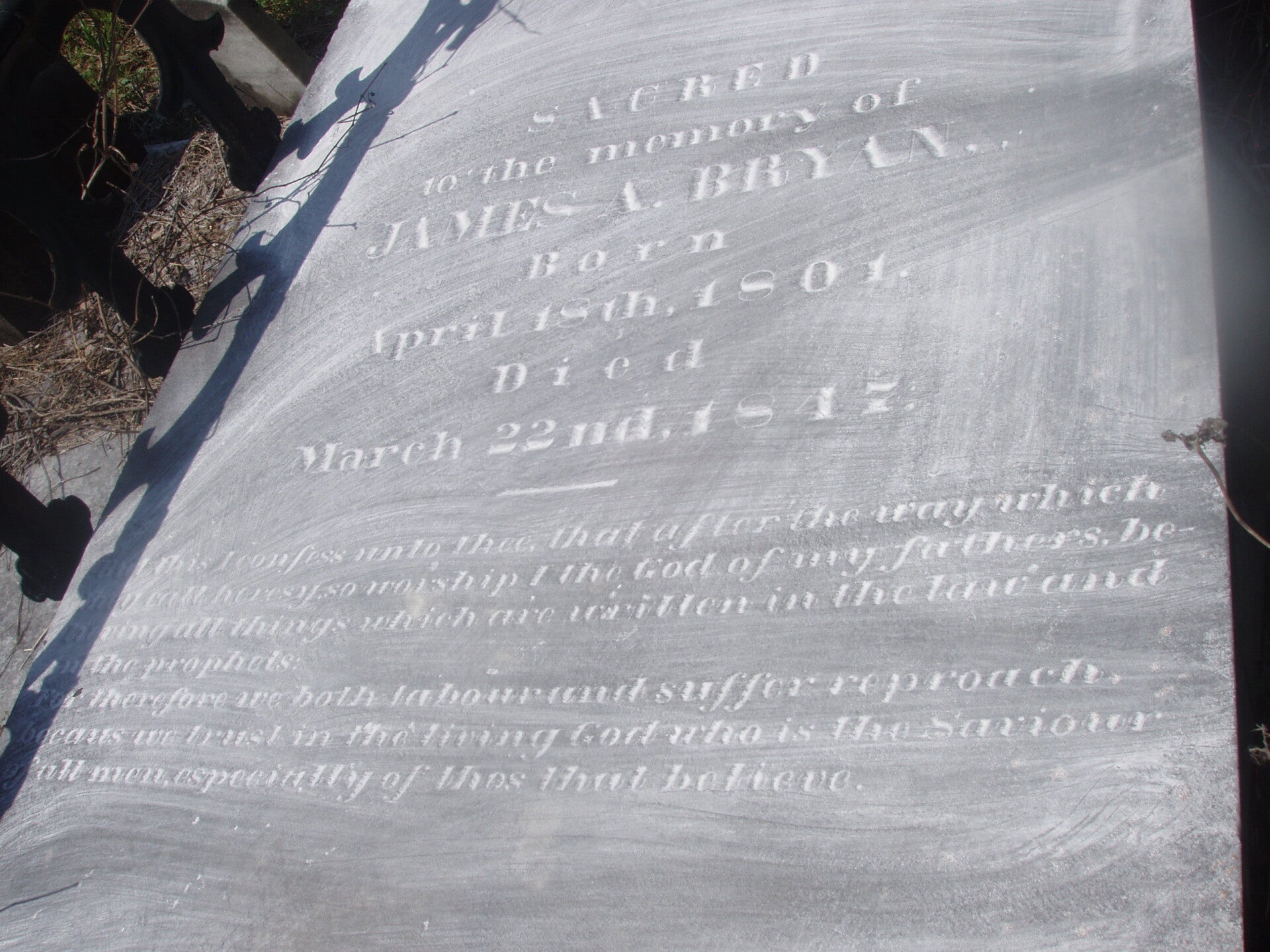
Born April 18th, 1801 · Died March 22nd, 1847
This I confess unto thee, that after the way which they call heresy, so worship I the God of my fathers, believing all things which are written in the law and in the prophets.
For therefore we both labour and suffer reproach, because we trust in the living God who is the Saviour of all men, especially of those that believe.
Robert came home from Cincinnati to a plantation that had not stopped. He administered the estate of James A. Bryan for nineteen years — through the peak cotton years, through the war, through the conversion from cotton to corn when the markets closed, through Sherman’s passage forty miles to the east. The estate was finally distributed on April 10, 1866. Five receipts signed on the same day before the same Justice of the Peace. The accounts settled. Abner received the house and the land.
The inventory filed at James’s death is the founding document of this archive. Every record that follows — every annual return, every cotton sale, every name in the Freedmen’s Bureau contract — traces back to the Monday in March 1847 when the office door stood open and no clients came.
James Averette Bryan purchased Lot 242 in 1828 on land the Creek Nation had ceded by treaty seven years before. He built a house intended to last. It is still standing. He died at forty-five and his estate ran for nineteen more years. He got what he built for.
Lynton Book, Chapters One through Six and Epilogue · 1832bryanhouse.com
Grave marker · Bryan Cemetery · Kathleen, Georgia · Find a Grave memorial 128000901
Ocmulgee Academy Independence Day account · Milledgeville, Georgia · July 4, 1824