
J.A.B.
Every bale the Bryan estate ever sent to market carried the same mark pressed into its face before it left the gin house: J.A.B. The initials of James A. Bryan, who died March 22, 1847, and whose cotton went to Macon for nearly two decades after his death. His son Robert was twenty years old when he took over as administrator. The brand did not change.
The mechanics of moving a cotton crop to market were the same every year. The seed cotton came in from the field and went to the fifty-saw gin, which separated fiber from seed. The gin fed the cotton screw — a press worked by draft horses walking in a circle, compressing the ginned fiber into bales. Each bale was weighed, numbered, and branded. Then it went down the Sandbed Road to the Toby Sofky toll bridge — eight dollars for the crossing, recorded in every single annual return from 1847 through 1861, fourteen consecutive years, not once omitted — and from there to Cotton Avenue in Macon, where brokers handled the sales. Every bale numbered sequentially. Every price recorded to the fraction of a cent.
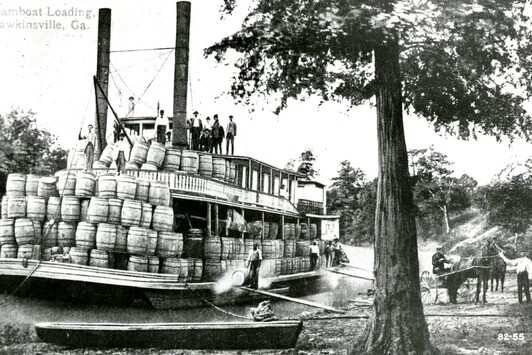
Hawkinsville — the Ocmulgee River terminus, twenty miles from the plantation. Cotton traveled from here south to Darien and Savannah.
The buyers appeared year after year in the ledger: E.A. Wilcox, John S. Hoye, John S. Nelson, A. LeSueur. The same names, the same street, the same transaction. In the early years the estate used the Ocmulgee River route — wagon to Hawkinsville, then shallow-bottom steamboats south to Darien and Savannah. By the 1850s the road to Macon was the established route, the brokers on Cotton Avenue the established relationship.
The price moved with the market and rewarded patience. In June 1848 the estate sold 55 bales at 5.5 cents a pound — the largest single sale in the early record — then watched the price nearly double to 10 cents by that fall. The same gin. The same hands. The same road.
By 1852 the operation was running at full capacity. Ninety bales across five transactions — $3,668 in cotton income for the year. Robert was twenty-five and managing everything simultaneously: the brokers, the provisioners, his physician's pharmacy, four siblings in school, and a plantation household of forty-plus people whose annual shoe and blanket orders arrived from Macon in the same weeks the cotton was going out.

Cotton Avenue, Macon — ca. 1870. Brokers Patten Collins & Co. and Adams & Reynolds handled Bryan cotton on this street for more than a decade.
The fifty-saw cotton gin required constant attention. The gin that processed every bale the estate sold was overhauled, repaired, and eventually replaced across the years of the record.
| 1852 | Samuel Griswold files all fifty saws, installs a new main shaft, fifty-one new ribs, new cotton box and brush — $48.50. His factory at Griswoldville is destroyed by Sherman in November 1864. |
| 1855 | Alex M. Thigpen repairs the gin, $6.25. Joseph Cooke & Son repairs the cotton screw. Both machines serviced in the same season. |
| 1858 | Complete new fifty-saw gin purchased from Thigpen — $95.44. The old gin had reached the end of its working life. Ninety-two bales follow that fall — the largest harvest in the record. |
| 1861 | The cotton screw rebuilt entirely by Henry Balkcom for $47.00 and four bushels of rye — the first barter transaction in the returns. Only fourteen bales sold that year. |

The Houston Factory — ca. 1897, four miles east of Perry. James A. Bryan helped survey and dam Mossy Creek to power this mill in 1843.
Not all Bryan cotton made the road to Macon. James A. Bryan had helped survey and dam Mossy Creek in 1843 to power the Houston Factory — a cotton mill four miles east of Perry in which he held partial ownership. Every year the mill carded the plantation's wool and returned it as yarn. The relationship ran in both directions.
In January 1859, Factory superintendent A.M. Crowder purchased fifteen bales of J.A.B. cotton directly at 11 cents a pound — $803.55, bypassing the Macon brokers entirely. In February 1861, ten more bales at $446. When the Macon supply lines began tightening with the war, the Factory manufactured 185 yards of kersey from the plantation's own wool — cloth made from the estate's raw material, processed a few miles away and returned in usable form.
Crowder would later serve as one of five commissioners certifying the final distribution of the Bryan estate in 1866 — the same man who had bought their cotton eight years before, still present at the close.
The 1858 season was the peak. Ninety-two bales. Cotton income of $4,685. A new fifty-saw gin had been purchased in April. The main house roof was replaced that fall — 13,000 shingles from Joseph Tooke & Son, 31 squares of shingling. Bear Pond, in the valley below the Sandbed Road, was ditched in July. A boy named Henry was purchased in November for $1,170. The estate closed 1860 with a balance of $8,263.19 — the strongest financial position in its history. That return was filed April 10, 1861. Fort Sumter fell two days later.

1859 — “16 Bales Cotton by Adams & Reynolds for James A. Bryan Dec’d.” Each bale weighed, numbered, priced to the fraction of a cent.
The 1861 return tells what happened in a single number: fourteen bales sold, all in December, at seven cents a pound. Total cotton income for the year: $483.26. The estate had sold 92 bales in 1858. Seventy-three in 1859. Sixty-one in 1860. Fourteen in 1861.
On April 25, 1862, Adams & Reynolds sold eight bales of J.A.B. cotton to C. Wise for $310.50 net. That was the last cotton sale in the war-era record. After April 25, the cotton entries stop.
What followed was a complete conversion. Pindars, ground peas, lard, corn — food crops sold to Macon merchants across the fall and winter. Salt, which had been a routine line item at a few dollars a quantity before the war, cost $25 a bushel by November 1862. Shoes that had always come from Macon were made locally — thirty pairs from J.W.H. Murfee at a dollar each. In March 1863, one thousand bushels of corn went directly to the Confederate government at $1.25 a bushel. On January 20, 1863, the ledger recorded: A.C. Bryan cash going to war — $7.50. Abner Bryan was twenty-six years old. The ledger moved to the next line.

Houston Lake Country Club — built on the site of the Houston Factory mill pond. The lake is the same Mossy Creek impoundment James A. Bryan helped create in 1843.
The war ended April 9, 1865. By September, cotton was moving again. Knott & Howel bought four bales at 24 cents a pound, payment in greenbacks — the currency specified on the receipt. In March 1866, Harris & Ross sold sixty-two bales to E.A. Wilcox at 28 cents a pound: $8,751.90 net after storage, stamps, and commissions. The largest single cotton transaction in the entire estate record. The brand on every bale was J.A.B.
The Final Distribution of the estate was signed the following day.
Where the Houston Factory stood, Houston Lake Country Club now sits — fairways, lake-view homes, an eighteen-hole course. The lake is the mill pond that James A. Bryan helped create in 1843 when he surveyed and dammed Mossy Creek. The same water that powered the machinery that carded the wool and bought the cotton is now the fourteenth hole. Cotton is still grown in Houston County. It has been, without interruption, for nearly two centuries.
- Estate of James A. Bryan, Deceased · Annual Returns 1847–1866 · Houston County Court of Ordinary · Georgia Archives
- 1847–1850 Vouchers · 89 documents · founding years of the estate
- 1852–1865 Annual Returns · Houston County probate records · transcribed from original documents
- Houston Factory records · A.M. Crowder, Superintendent · referenced in estate returns 1847–1866
- 1832bryanhouse.com · Estate Records Timeline