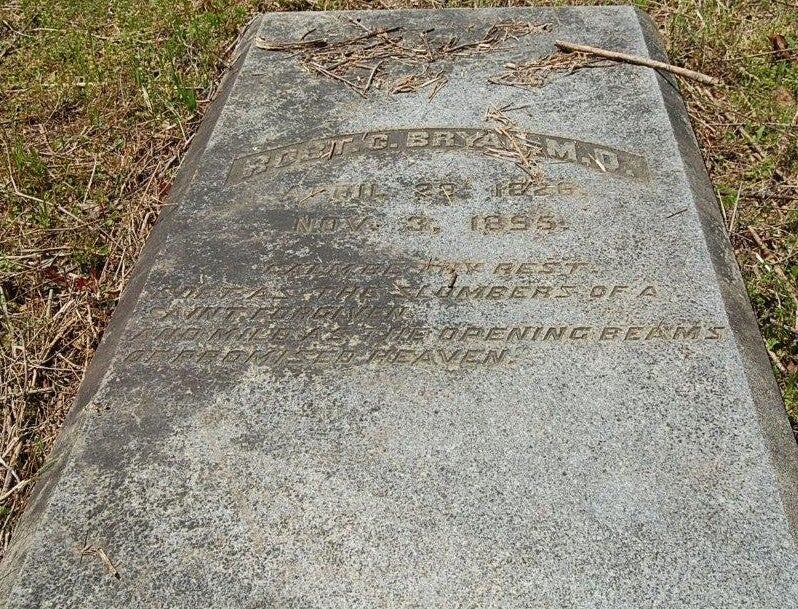
Robert Campbell Bryan
Robert Campbell Bryan was born in 1826, the first child of James A. and Catharine H. Bryan. He grew up on the Houston County frontier as his father assembled the plantation piece by piece — the land survey, the log house, then the finished house going up on Lot 242 while Robert was six years old. By the time the wagons rolled west down the Buzzard Roost landing trail in the autumn of 1832, he had been watching the ground cleared and the bricks laid for four years. He was the oldest of what would become ten children.
He left for Mercer University at Penfield, graduating with first honor from a large class before the college moved to Macon. He then attended the Cincinnati Medical College and again took first honor from his class. A chair was offered at a handsome salary. He had six diplomas at the time of his death.
James A. Bryan died on Monday, March 22, 1847. He was forty-five years old. Robert was twenty, in Cincinnati, his career ahead of him. He came home.
It was early spring when James died. A Monday. March 22, 1847; forty-five years old. It must have been unexpected — Robert was in Cincinnati, twenty years old, having just graduated first in his medical class, a faculty teaching career ahead of him that he would never begin.
Lynton Book · Chapter FourSix weeks after the death, he was appointed administrator of his father's estate. The inventory was filed on November 5, 1847 — signed by three appraisers and certified by Robert C. Bryan, Administrator. The estate stood at $36,967. Forty-one people were listed by name, each with a dollar amount beside it. The land ran to more than 1,188 acres across eight Georgia counties. He was twenty-one years old.
The Macon Telegraph obituary, written nearly fifty years later, said he had been offered a chair at a handsome salary but was compelled to return to the plantation to look after the estate. Whether the writer knew him is not recorded. What the record shows is nineteen years of annual returns, filed without interruption, and a final distribution in which his name does not appear among the distributees.
Inventory and appraisement of all the Goods and chattels, rights and credits of James A. Bryan, Deceased, as far as was produced to us by Robert C. Bryan, Administrator, to the best of our judgement and understanding.
— Wilson Smith, Wm. Haddock, M. Joiner · Appraisers
Robert administered the estate of James A. Bryan from 1847 to 1866 — nineteen years. Every cotton sale, every provisioning order, every school fee for six siblings, every overseer's contract passed through him. He signed every major receipt in the archive. The estate records name him more than any other individual across two decades of documents.
In the founding years alone, the work ran simultaneously across fronts that would have occupied several men: managing cotton sales through Macon brokers, building a new gin house board by board across 1848 and 1849, keeping six siblings in school, paying the plantation's legal accounts, and running a medical practice on Sandbed Road at the same time. Troup and Hugh were in LaGrange at their father's death; Robert settled their accounts in November 1847. Nancy was in Macon at school; Robert left $20 with a trusted intermediary for her use and paid her dentist bills. Laura was born in May 1847, weeks after her father died. Robert was her legal guardian when the estate closed.
Robert kept the doors closed, the fire warming the room. He sat where his father had sat, the account books open to the page that needed his attention, the overseer's contract, the broker's commission, the school fees for six siblings whose education the cotton would pay for as it had always paid for. He picked up the pen.
Lynton Book · Chapter FiveThe cotton carried his father's initials on every bale. The J.A.B. brand remained on every bale the estate produced for nineteen years after James's death. Robert's own cotton — grown on his separate plantation operation — carried a different mark: R.C.B. The dead man's initials moved down the Sandbed Road to Macon for nearly two decades. Robert's own brand traveled alongside them.
| Year | Bales sold | Notable |
|---|---|---|
| 1847 | 7 | First season. J.A.B. #1–7. Robert signs for the receipt. |
| 1848 | 55+ | 55-bale sale in June — largest in the pre-war record. Price 5.5¢/lb. |
| 1858 | 92 | Largest harvest in the full record. New gin purchased April 1858. House re-roofed same year. |
| 1862 | 8 | Last cotton sale in the war-era record. Plantation converts to food crops. |
| 1866 | 62 | Final distribution. 62 bales — largest single asset, $3,761.90. J.A.B. brand for the last time. |
At the estate's peak in 1858, Robert managed its most active year simultaneously: 92 bales to market across seven transactions, a new 50-saw cotton gin in April ($95.44), a full re-roofing of the main house in the fall (31 squares, $120.24), the ditching of Bear Pond in July, three students in school on the estate's account, and the purchase of a boy named Henry in November for $1,170. The estate's balance that year stood at $5,053.20 — the strongest position it ever held. He administered all of it.
Robert practiced medicine continuously through the administration years. His patient accounts run through the estate returns from 1847 forward — pharmaceutical orders from Macon, instruments purchased from Heywood's pharmacy, and named neighbors receiving medicines that Robert either delivered himself or had sent. By 1858 the instrument list included a glass pessary, ergot for labor management, custom-prepared blistering ointment in eighteen-ounce quantities, and tartar emetic ointment ordered twice. The estate paid the pharmacy accounts. Houston County used the physician on Sandbed Road.
Robert stayed. When Troup went to Virginia in June 1861 and Cornelius, Hugh, and Abner mustered together in Company K on July 3rd, Robert remained on Sandbed Road. The estate and the plantation required it. Someone had to keep the accounts, manage the harvest, and hold the household together as the commercial world the plantation depended on began to come apart.
Robert ran the plantation. He had been administering the estate since 1847 and he continued through the war the same way he had always continued, methodically, practically, with the full attention of a man who understood that the estate his father had built was a thing worth preserving and that preservation required work.
Lynton Book · Chapter SixEight bales of cotton sold in April 1862 — the last cotton sale in the war record. The plantation that had sold 92 bales in 1858 converted entirely to food production: peanuts, ground peas, corn, lard. In March 1863, one thousand bushels of corn went directly to the Confederate government at $1.25 a bushel. Salt reached $25 a bushel by November 1862. Shoes were made locally. Robert sold plantation syrup back to Heywood's pharmacy and credited it against the medical account. The estate bought Confederate bonds. It sent men south to dig fortifications at Savannah. When Cornelius came home from Virginia with a disability discharge in May 1862, Robert needed him and put him back to work as overseer.
Abner left for Confederate service on January 20, 1863 with $7.50 from the estate. The ledger recorded the amount and moved to the next line. Robert continued to file the annual returns.
On April 10, 1866 — nineteen years, two weeks, and nineteen days after James A. Bryan's death — five commissioners proceeded to the performance of that duty and made distribution. The estate appraised at $23,840.30. Five distributees received equal shares of $4,768.06: Abner, James S., Laura, Catharine P. (Stewart), and Honora (represented by her husband Thomas Whitehurst). Robert is not named among the five distributees at the final closing.
He represented Laura in the distribution. She was the tenth child, born weeks after her father died. Robert had administered the estate for her entire life. He signed for her share on her behalf. The first thing Abner did after the distribution, before settling into what came next, was to go to the Houston County court and adopt Laura as his ward. Robert had already made himself her guardian through the administration. She was eighteen.
Robert also signed a separate Freedmen's Bureau labor contract on January 14, 1867 — one day before Abner and James S. signed theirs. Eleven freedpeople: the Lawson family (five members), the Allington family, and members of the Jones and Boston families. The contract was made on his own account, not on behalf of the estate. Nineteen years of administering his father's plantation, and he had built a separate operation alongside it, branded R.C.B., running its own cotton to market, signing its own labor agreements.
This contract made and entered into this 14th day of January 1867 between R.C. Bryan of the County of Houston and of the State aforesaid of the first part and Peter Lawson, Ennan Lawson, Richmond Lawson, Cilia Lawson, Olivia Lawson, M. Abington, Titus Jones, Venus Jones, Susan Boston & Green Boston, freedmen and women of the County of Houston and of the State aforesaid, of the second part.
After the estate closed, Robert worked as a physician and planter in the Kathleen area. He donated the railroad land on the condition that a depot and settlement be established at the stop twenty-seven miles south of Macon. The station was named for his daughter Nancy Katherine, who went by Kathleen. She was born in 1852 and lived in the town that bore her name. Robert died in 1895.
Robert C. Bryan — John's uncle, one of the best known and most learned physicians in the state, a man whose patients came by wagon from Dooly and Pulaski counties — had donated the railroad land on the condition that a depot and settlement be established there. The stop had been named after his daughter Nancy Katherine, who went by Kathleen. She still lived in the town named for her.
Lynton Book · Chapter OneLynda Lee first heard the story of Kathleen Station on the morning she and John rode the buggy south from the depot in 1901. The town named for Robert's daughter was the landmark that placed the plantation on the map — two miles south of the station, around a bend in the Sandbed Road, the mulberry trees first.
Robert appears in the Lynton Book as a presence felt throughout the documentary record rather than as a character described at length. Lynda Lee understood him primarily through what he had done: the town named for his daughter, the estate filed and administered, the physician's road to the property. By 1901, when she first visited the house, Robert had been dead six years. His daughter Kathleen was forty-nine and still living in the town that bore her name.
At the 1926 reunion, John's sister Sarah spoke of the one who had loved the old homestead more perhaps than he knew — meaning John, seven years gone. But it was Robert who had made the homestead possible in its post-1847 form: who had held it through nineteen years of annual returns while his siblings grew up, went to school, went to war, came back, and built their lives in its shadow. The record is his record more than anyone else's.
Robert C. Bryan died late Saturday night, November 3, 1895, at Kathleen, Georgia, and was buried the following day. He was sixty-nine years old. He is buried in the Bryan family cemetery, four hundred feet south of the house his father built in 1832. His marker reads: Robt. C. Bryan, M.D. · April 29, 1826 · Nov. 3, 1895.
Calm be thy rest,
Soft as the slumbers of a saint forgiven,
Mild as the opening beams
Of promised heaven.
Dr. Robert C. Bryan, who died at Kathleen late Saturday night and was buried yesterday, was one of the best known and most learned physicians in the state.
He graduated at Mercer University before the college was removed from Penfield to Macon, and took first honor from a large class of brilliant students. After leaving Mercer, Dr. Bryan attended the Cincinnati Medical College, at which college he also took first honor from his class.
As an evidence of Dr. Bryan's learning, at the time of his death he had six diplomas.
After graduating at the Cincinnati college, he was offered a chair in that institution at a handsome salary, but his father, who was a large property owner and successful farmer of Houston county, died and Dr. Bryan was compelled to return to the plantation in Houston to look after the estate.
Besides being famous in the state as a physician, Dr. Bryan was a successful planter, and accumulated a large fortune before his death.
He leaves two daughters — Mrs. Jerry H. Davis and Mrs. J. O. Wardlow — and five grandchildren. Being a most affectionate father, his home was the scene of a family reunion fifty-two times in each year, and thus all his Sundays were spent.
His practice extended over every section of the state within his reach, it being no uncommon occurrence for people to visit him from Dooly and Pulaski counties on beds made down in wagons.
His daughter Kathleen — Nancy Katherine, born 1852 — lived until 1937, eighty-five years old. She outlived her father by forty-two years and was still living in the town that bore her name when Lynda Lee first rode past the station in 1901.
The obituary says nothing about the nineteen annual returns. It says nothing about the gin house built board by board, the siblings kept in school, the war years managed from the same desk where his father had sat. It says he was compelled. The record does not use that word. The record uses his signature, filed once a year, for nineteen years, without interruption.