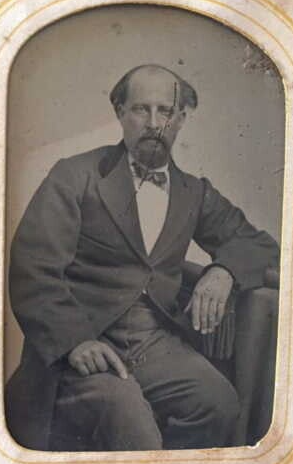
Abner Council Bryan
Abner Council Bryan was born February 5, 1836, in Georgia, the eighth child and fifth son of James A. and Catharine H. Bryan. He grew up on the plantation with nine siblings, the youngest of the brothers who would go to war together in the summer of 1861. The Lynton Book places him at his books in the plantation's early years — Abner and James still studying while Robert administered the estate and the cotton went to Macon. When his father died in March 1847, Abner was eleven years old.
Abner appears in the estate returns as one of the younger heirs — his school fees, board, and clothing running through the ledger in the same entries as his brothers and sisters across the 1850s. He was living on or near the plantation in 1862, close enough to sign for estate business. On December 16 of that year the ledger records him receiving payment for ninety-seven bushels of ground peas sold to McCallie & Jones in Macon — $133.37, signed on the estate's behalf. It is his last signature in the returns before the war.
On July 3, 1861, Abner mustered alongside his brothers Cornelius and Hugh in Company K of the 11th Georgia Infantry, Houston County. Three brothers in the same unit, the same way they had grown up together on the same ground, knowing the same roads between Perry and Macon.
Abner, Cornelius, and Hugh mustered together on the third of July in Company K of the 11th Infantry, three brothers in the same unit, the same way they had grown up, together, on the same ground, knowing the same people and the same roads between Perry and Macon. James was still at home; his time would come. Robert stayed. Someone had to.
Lynton Book · Chapter SixOn January 20, 1863, the estate ledger records a single line: A.C. Bryan cash going to war — $7.50. He was twenty-six years old. The entry sits between a receipt for four empty barrels and a fabric purchase. The estate had sold one thousand bushels of corn to the Confederate government the previous month for $1,250. It handed Abner $7.50. The ledger moved to the next line.
He does not appear again in the returns for three years. What he did between January 1863 and April 1866 is not recorded in any document in this archive.
In April 1866, nineteen years after James A. Bryan died and Robert came home to administer the estate, five receipts were signed on the same day before the same Justice of the Peace. The estate distributed. Abner received the house and the original two hundred and two acres — Lot 242, the ground his father had purchased in 1828 and built on in 1832.
Before the distribution was settled, he went to the Houston County court and adopted Laura — the tenth child, born weeks after their father died, who had spent the war years being kept in school by an estate that understood what she would need. He made himself her legal guardian. Then he went back to work.
He claimed the house and the original two hundred and two acres when he came home from the war and his father's estate was finally settled. He adopted Laura, the last child, who had never known her father. He was thirty years old and honest and willing, and the world he came home to was not the world he had left.
Lynton Book · Chapter SevenOn January 15, 1867, Abner and his brother James S. signed a labor contract with nine freedpeople — the Boston family across three generations, Littleton Jones, William Chase, Solomon Walker, and Frank Rawls. Every freedperson signed with a mark. The contract stated its terms plainly: Abner and James S. agreed to treat their employees with kindness and respect. The employees demanded the same.
The cotton still needed planting. The ground still needed tending. What had changed was everything else — the labor, the terms, the arithmetic of a working farm. It was a farm now, not a plantation. The years went by.
Abner married Harriet Taylor in October of 1867. She came to the house and made it hers. John was born in January of 1869. Mary in 1873. Sarah in 1874. The house filled again with children. Robert was three miles up the road at Kathleen. The county was learning what came after the war — the new labor, the new terms, the world without the arrangement that had made it run. Some learned faster than others. Abner kept the land. He kept the house. He worked the ground and the ground did not return what it once had.
The Houston Home Journal described him as an upright, honest man, a good citizen, held in high esteem by his many friends. He was a consistent member of the Methodist church. He had been in apparent robust health when the end came, though he had for some time been affected with heart disease.
In May of 1881, he conveyed the house and the land to Harriet. A judgment had come down from the Houston Superior Court — the consequence of a surety gone wrong, the debt of another man falling on those who had signed alongside him. The land was pointed at. Harriet's name on the deed was meant to hold it safe.
It was the move of a man who understood what he had and what it would cost to lose it, and who loved his wife well enough to put her name on the only thing he had left to give her.
Lynton Book · Chapter SevenHarriet died in October of 1888. She was forty-two years old. The protection Abner had built dissolved with her. By January of 1889 the land was listed in the sheriff's sale notice, and Abner was living on it as tenant in possession of his dead wife's estate — the same ground his father had purchased sixty years before, now held at the sufferance of a court.
In November of 1889 he went before the county Ordinary and swore that the inventory was full and true and correct. He signed his name. He rode back to the house. The land was listed in the inventory at one thousand dollars. In 1861 the estate of Catharine H. Bryan had valued a boy named Henry at eleven hundred dollars — the land worth less, twenty-eight years later, than one person on it had been appraised at.
On December 8, 1889, Abner Council Bryan was suddenly stricken to the floor at his home near Kathleen. Death at once claimed its victim. He was fifty-three years old.
The sudden death of Mr. A.C. Bryan last Sunday was a surprise and a cause of sorrow to his many friends in Houston county. Though in apparent robust health, he has for some time been affected with heart disease, and when he was suddenly stricken to the floor, at his home near Kathleen, last Sunday, death at once claimed its victim. The burial took place at the family burial ground Monday. Mr. Bryan was about 55 years old, an upright, honest man, a good citizen, held in high esteem by his many friends. He leaves two brothers, Dr. R.C. and Mr. J.S. Bryan, and several children in this county, who with a large circle of friends sincerely mourn his death. Mr. Bryan was a consistent member of the Methodist church. The Heavenly Father hath claimed his own.
He is buried at the Bryan Family Cemetery in Kathleen, Houston County, Georgia. The obelisk carries his name on one side and Harriet's on the other, with individual slabs. Find a Grave memorial 128002934.
He left John, who was twenty. And Mary, who was sixteen. And Sarah, who was fifteen. John became their guardian, held what there was to hold, kept the family together on the two hundred acres with the steadiness of a young man who understood that steadiness was what the moment required.
He was born on this ground and died on it. His father had built the house four years before he arrived; he received it the year he turned thirty and kept it for the rest of his life. It was his, the same way it had been his father's — the same two hundred and two acres, the same six columns, the same cemetery four hundred feet south where the family had been burying its dead since 1847. He went to war with $7.50 from the estate. The Lynton Book records what he came back to: in April of 1866, nineteen years after James died, five receipts were signed on the same day before the same Justice of the Peace. The estate distributed. Abner received the house and the land. He left it to John the only way he could — by dying on it.
- Estate of James A. Bryan — Annual Returns 1847–1865 · Houston County Court of Ordinary · Georgia Archives
- 1866 Final Distribution, Estate of James A. Bryan · Houston County Court of Ordinary · Georgia Archives
- 1867 Freedmen's Bureau Labor Contract · A.C. & J.S. Bryan with Freedpeople · January 15, 1867 · Houston County
- Lynton: A History of the 1832 Bryan Plantation House · Chapters Five, Six, Seven
- Obituary — Houston Home Journal · December 12, 1889
- Find a Grave — Abner Council Bryan · Memorial ID 128002934 · Bryan Family Cemetery, Kathleen, Houston County, Georgia