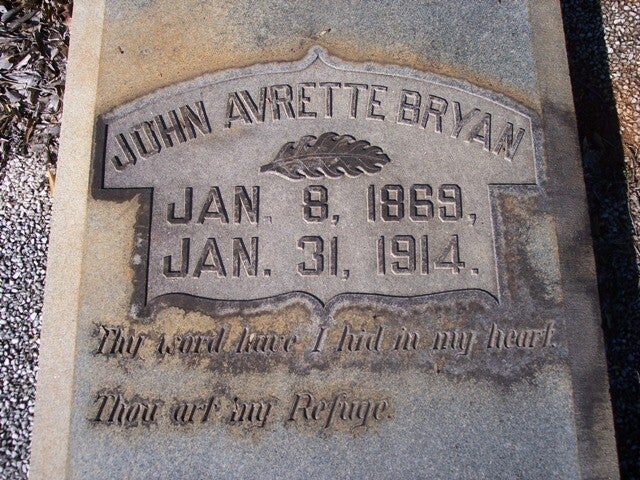
John Averette Bryan
John Lee Bryan (1905–1959)
Lynda Lee Bryan (1910–1992)
John Averette Bryan was born in January 1869 in Houston County, the first child of Abner Council Bryan and Harriet Taylor. He was born into the house his grandfather James had built on Lot 242 in 1832 — three years after the estate that had sustained the family through nineteen years was finally settled and the ground passed to Abner's name. He grew up there, on ground his grandfather had cleared and his father had struggled to keep.
Abner married Harriet Taylor in October of 1867. She came to the house and made it hers, quietly and completely, the way Catharine had before her. John was born in January of 1869. Mary in 1873. Sarah in 1874. The house filled again with children, which was a kind of prosperity, though not the kind that appears in a cotton ledger.
Lynton Book · Chapter SevenWhen Abner died in December 1889, John was twenty years old. His sisters Mary and Sarah were sixteen and fifteen.
He left John, who was twenty. And Mary, who was sixteen. And Sarah, who was fifteen.
John became their guardian, held what there was to hold, kept the family together on the two hundred acres with the steadiness of a young man who understood that steadiness was what the moment required.
In the summer of 1890 the Houston Home Journal noted that Mr. J. Avrette Bryan of near Kathleen was visiting relatives at Gordon, where Nancy still kept the household Wilkinson had left her. The family roads still ran between the old homestead and Gordon, the connections still holding, the house still standing on Lot 242 with its six columns and its west-facing porch.
He was twenty-one years old. He did not yet know he was going to ride toward Talbotton, or that in Talbotton a young woman was already writing down everything she saw.
Lynton Book · Chapter SevenBefore he became a representative of the Atlanta Journal, John Bryan was a schoolteacher — and a well-regarded one. He taught at Unadilla in Dooly County and at Eastman in Dodge County. The social columns of middle Georgia carried him as “Prof. J. Avrette Bryan” through the early 1890s. He came home to Kathleen for Christmas 1892, then contracted to teach at Baldwinville in Talbot County — the county where he would eventually be buried.
Prof. J. Avrette Bryan has closed his school service at Unadilla, and is now at his home at Kathleen for the Christmas vacation. He has contracted to teach at Baldwinville, Talbot county, next year, and will go over there in time to begin the spring term early in January. The patrons of that school are to be congratulated, as Prof. Bryan is one of the very best young teachers in the state.
Houston Home Journal · December 1892He passed through Macon in November 1895 to attend the funeral of his uncle Robert C. Bryan. The title Professor followed him into Talbotton and into the columns where a young woman had been putting his name into print for years before he put her name into a deed.
While teaching at Eastman, John Bryan was simultaneously working the Kathleen plantation — cultivating a large number of acres of watermelons himself, buying additional melons from other growers, and shipping north to Chicago and Cincinnati. That summer of 1896 he made the trip himself, following the freight to market, spending weeks with the commission men and their account books to understand how the business actually worked. He made no money. He knew exactly why, and he said so plainly when the Macon Telegraph found him on his way home.
Prof. J. Averette Bryan, a native of Houston of whom our people are proud, has been in Chicago and Cincinnati this summer looking after the sale of watermelons. Returning several days ago a reporter of the Macon Telegraph met Prof. Bryan, and we reproduce the following: Mr. Bryan is a highly capable school teacher at Eastman, but he also finds sufficient time to cultivate a large number of acres of watermelons on his plantation at Kathleen. He also buys watermelons that he ships to the markets.
In speaking of his trip to the West, Mr. Bryan, who is a young man of considerable intelligence and business judgment, said he made no money, but he learned how to make it in future, so that next year he will know exactly how to ship his melons to the best advantage.
Houston Home Journal · July 23, 1896 · reprinting Macon Telegraph interviewIt is a great mistake for the melon growers to always attribute the poor returns they receive for their melons to dishonest commission men, for it is very often that the grower himself is to blame by misrepresenting the weight of the melons in the car and by improperly packing them. Of course all commission men are not honest, but after being with them and having access to their books and letters for two weeks, I am satisfied that most of them are, and that they do the best they can by the people who ship them melons.
Shipments of Georgia melons are nearly over for this season, and I was advised by the commission men not to ship any more, as the South Carolina, Indiana and Missouri melons are now being shipped, and with the advantages in rates, prices will be low and there will be no money in shipping Georgia melons.
John A. Bryan · quoted in Macon Telegraph · 1896He was twenty-seven years old, teaching in Dodge County and farming the Houston County ground his father had left him, following his own freight to Chicago and sitting with the commission men’s books to understand the arithmetic of failure. The plantation his grandfather had built was still producing. John was the one working it.
By 1904 the Kathleen plantation was drawing guests from across the county. A saw-mill barbecue that May brought more than 125 visitors to the Old Bryan Homestead grounds — neighbors, families, visitors by invitation from many sections of Houston County. The Messrs. Bryan and families were the moving spirit. The ground that John had been farming and holding since his father’s death was, for an afternoon, a place of considerable celebration.
For years picnic in Houston has been synonymous with good fare, gayety and freedom from the cares incident to every day life. Upon the invitation of a kind and thoughtful friend, it was my pleasure to be a guest of the Williams Sawmill Company last Saturday. While the mill company was the moving spirit, it was ably assisted by the Messrs. Bryan and families.
About 10 o’clock we arrived on grounds, the grove in front of the Old Bryan Homestead, in the Lower 11th district, and found some 125 or more visitors already there. The beautiful young ladies, the homely boys, and the widows, handsome and gay, all seemed to enjoy themselves. The politician was conspicuous by his absence.
Houston Home Journal · May 10, 1904 · signed The JudgeShe had been putting his name into the newspaper for four years before he put her name into a deed. That was the courtship: set down in the social columns of the Talbotton New Era in the precise language a small Georgia town required, the true thing carried inside the form the occasion allowed.
The many friends of Mr. J. A. Bryan of the Atlanta Journal and Miss Lynda Lee will be interested to know that they are soon to be married at the home of Miss Lee in Talbotton. Both have a great many admiring friends in Macon, where Mr. Bryan has lived, being connected at one time with The Telegraph, and where Miss Lee has several times visited relatives. Few young people in Georgia are better or more favorably known.
Macon Telegraph · November 4, 1901A beautiful wedding was that of Mr. J. Averett Bryan and Miss Lynda Lee, which occurred in Talbotton yesterday at high noon. Quite a number of friends were present from Macon, Atlanta and elsewhere in Georgia. After the ceremony, Mr. and Mrs. Bryan went on an extended bridal tour through the Southwest. When they return their home will be at Talbotton, where the bride was reared from childhood. The ceremony occurred in the historic Methodist church of Talbotton, and it was beautiful and impressive. The building was filled to overflowing with the well-wishing friends and relatives of the couple.
Macon Telegraph · December 12, 1901He had been describing the Old Bryan Homestead to her for years before she first saw it. He wanted her to see it in good light.
The buggy left Talbotton before the dew had burned off.
It was John’s idea to start early. He had been describing the Old Bryan Homestead to her for years — the way the porch faced west into the valley, the pecans standing around it like a congregation, the mulberry grove along the approach, older than anyone could say with certainty. His grandfather James had built it at the very edge of the Georgia frontier, on land that had been Creek country until ten years before the bricks were laid. The world the house was built into had not lasted long. The house had lasted considerably longer. He wanted her to see it in good light.
She was twenty-nine years old. She had never seen Houston County.
They changed at Macon, taking the Macon and Florida Railway south toward Perry and Kathleen. Two miles south of the station the road turned to fine pale sand, the wheels of the buggy nearly silent on it, the horse’s hooves muffled to a soft rhythm. John was watching the road with the expression of a man coming home.
“Around this bend,” he said.
The mulberry trees came first. A grove of them, full and green still in the early autumn, standing along the approach to the house in the way that trees stand when they have been there long enough to consider themselves permanent. And then, through and beyond them, the house. Six white columns across the front. The porch facing west. Pecan trees standing around it with the comfortable authority of trees that have been in one place long enough to stop noticing they are trees. Across the road, large oaks marked the edge of the land where it leveled before dropping into a valley, and beyond the valley the sun was doing something particular with the light that she wanted immediately to write down and was not sure she could.
John was watching her.
“Well,” she said.
He smiled. He had always been able to tell when she was composing.
Lynton Book · Chapter EightBy the time of his engagement, John Bryan had moved from teaching into journalism — first with the Macon Telegraph, then as a traveling representative of the Atlanta Journal, covering the southeast by railcar. The engagement notice identified him by his paper, not his former profession. The Journal was what he was.
They were married in December 1901. She became Mrs. John Averette Bryan in the way she became everything: completely, with her full attention, without surrendering any part of what she already was. The column continued. The New Era continued. The household arranged itself around two people who both knew how to run a life and had the good sense not to interfere with each other’s methods.
He went where the work took him and came back and the household received him and continued.
Lynton Book · Chapter EightThe work kept him moving through the southeast. The memoirs Lynda Lee kept of their son John Lee in 1909 and 1910 show John traveling to Jacksonville, Savannah, Valdosta — the boys sometimes with him on a stretch of the route, Lynda Lee at the Talbotton office running the New Era while he was away. He was a present and affectionate father in the time he had. He was home when it counted.
I laughed when you referred to Lee’s excessive charges for interest. He charged me fifty cents for fifteen and nearly ran me crazy dunning me for it. He is a sight — almost a robber where money is concerned.
Quoted in Lynda Lee Bryan’s 1909 Memoirs · bryanplantation.blogspot.comCabaniss came first. Then John Lee. Then, on an evening in June 1910, a baby sister was left at the home of John Lee Bryan, and Cabaniss woke his brother to tell him, and in the morning they rushed pell-mell to their mother’s room, and the baby was presented to Lee as his own, and he wanted to know where the basket was, the basket in which the angels had brought her. His mother pointed to a rose-colored basket on the table near her bed.
She named the baby Lynda Lee.
Lynton Book · Chapter EightHis work for the Journal carried him across the southeast, but his roots in the Confederate memorial world ran alongside it. In 1904 the Talbotton Memorial Association selected him as their memorial day orator — the same year Lynda, as UDC president, was writing the monumental note for the town’s Confederate monument. They were doing this civic work together.
Houston county has been honored in the selection of the orator for memorial day at Talbotton. Mr. J. A. Bryan, born and reared to young manhood in Houston county, will be the orator, he having been selected by the ladies of the Talbotton Memorial Association. The Talbotton New Era says in connection with his selection as memorial orator: “The ladies have indeed made a happy selection. Mr. Bryan loves the traditions of the South and delights in telling of the heroic valor displayed on the fields of battle by the boys who wore the gray. He is an orator of unusual ability and the people of Talbotton and Talbot county should congratulate themselves that they will have an opportunity of hearing him pay a tribute to the memory of the Confederate dead.”
Sandersville Herald · September 29, 1904John died on the thirty-first of January, 1914.
He had been riding the night train, the Pullman sleeper, the familiar route he had known for years, and somewhere in the cold the spring-loaded latch closed behind him. He was forty-five years old. Cabaniss was twelve. John Lee was nine. Little Lynda Lee was three years old and would not remember her father clearly. That was the particular weight of it, and she carried it without stopping, without explanation, forward into what the days required.
Lynton Book · Chapter EightThe envious grave has taken away from us James A. Bryan, so long the traveling representative of the Atlanta Journal. He died at his home in Talbotton Saturday morning of Bright’s disease, the foundations of which were laid several years ago from a cold contracted. He stepped out on the rear platform of a Pullman sleeper. The door was a spring lock, and he could not get back. The night was cold and he was nearly frozen when rescued. He was never in good health after that severe shock to his system.
Mr. Bryan was of joyous temperament, carried sunshine with him, at home or abroad, and was beloved all over the State. No man ever had more devoted friends. And he was a hard worker and true and loyal to his paper, the Atlanta Journal. Its interest was always near his heart.
His home life was beautiful and his love for his wife and children was of that gentle and tender nature which illustrated his noble manhood. The Bryan home was one of gracious hospitality. Southern hospitality is noted, but that of this home had a brand all its own. There was a distinctive flavor about it.
Macon Telegraph · February 6, 1914 · Note: the obituary was filed under “James Averett Bryan” — his grandfather’s name — in errorHe had owned the house since 1888 — nineteen years old when it passed to him from Abner’s estate, and twenty-six years it was in his name. He held it through the teaching years, through the courtship, through the marriage and the three children and the Journal route. What he did with it at the end is what the record carries.
The will named the house. She had known about the house, had sat on its porch in the autumn light of 1901 and felt, without quite being able to say why, that she was exactly where she was supposed to be. She had written about it in the reunion columns, had gone back every summer, had understood it as John’s inheritance and hers by extension. What she had not known, until she found it in the document, was what he had done with her name.
The Old Bryan Homestead. Mulberry Grove. Renamed, in those last pages, Lynton Farm. The first syllable of her name joined to the last syllable of Houston County. Permanent. Specific. His.
And now hers.
Lynton Book · Chapter EightIn the summer of 1926, twelve years after his death, his sister Sarah stood at the annual reunion under the oaks and spoke about him without naming him.
She spoke of her mother’s instructions at this place, her father rebuilding what the war had broken, and of the one who had loved the old homestead more perhaps than he knew. John, seven years gone, unnamed because he did not need to be named. She had left this ground as a girl of fourteen, she said. She had come back to it all her life. Every part of it spoke to her.
Lynton Book · Chapter NineJohn Averette Bryan was born in the house his grandfather built, raised on the ground his father struggled to keep, and died at forty-five with the familiar route still waiting for him. He taught school in four Georgia counties. He shipped watermelons to Chicago and came home having learned what he would need to know next year. He put a name in the social columns of a Talbotton newspaper for years before he gave that name to the house on Lot 242. The house his grandfather had raised in 1832, that his father had nearly lost and left to him, he renamed for the first syllable of his wife and the last syllable of the county he was born in. The reunions went on for decades after he was gone. The name went with them.
- Lynton Book · Chapters Seven, Eight, Nine · 1832bryanhouse.com
- Find a Grave · John Avrette Bryan · Memorial ID 22759504 · Talbotton City Cemetery
- Macon Telegraph · November 4, 1901 · Engagement Announced
- Macon Telegraph · December 12, 1901 · Lee–Bryan Wedding at Talbotton
- Macon Telegraph · February 6, 1914 · Obituary (filed under “James Averett Bryan” in error)
- Houston Home Journal · May 10, 1904 · Saw-mill Barbecue at Old Bryan Homestead
- Sandersville Herald · September 29, 1904 · A Houston Orator
- Houston Home Journal · Summer 1890 · Mr. J. Avrette Bryan visits relatives at Gordon
- Houston Home Journal · December 1892 · Prof. J. Avrette Bryan closes school at Unadilla
- Houston Home Journal · July 23, 1896 · Georgia Watermelons · reprinting Macon Telegraph interview
- 1909 Memoirs of Lynda Lee Bryan · January 1909 – June 1910 · bryanplantation.blogspot.com
- Abner Council Bryan estate records · Houston County Court of Ordinary · 1890–1895
- 1914 Will of John A. Bryan · renames homestead Lynton Farm