Growing Up Laua Bryan
Shaped in Margaret Mitchell's voice
In the dim, flickering light of the parlor, where the heavy scent of melting wax candles mingled with the raw ache of fresh grief, Catherine Bryan stood tall despite her swollen belly, her face etched with sorrow like lines carved by an unforgiving wind. Around her clustered eight of her children, their eyes swollen and red from tears, as they said their final goodbyes to the man whose booming laughter had once echoed through these very walls. Outside, in the young cemetery where morning dew clung to the grass like unshed tears, his body lay beneath a solitary oak, its ancient roots already cradling the promise of new life—a daughter who would never know her father's voice.
On a sweltering May day in 1847, amid the vast cotton fields of the Georgia plantation that stretched like endless waves under a relentless sun, Laura Bryan entered the world with a fragile cry that seemed to pierce the heavy silence of mourning. She was the tenth child, the youngest, born into a home still draped in black crepe, for James A. Bryan had been taken by death just weeks before. Catherine, bowed by the weight of loss, held her newborn close, feeling the tiny heartbeat against her own weary one—a flicker of hope in a house shadowed by absence.
Laura's earliest days unfolded in that throbbing heart of the plantation, where the air hummed with the distant songs of laborers and the rhythmic creak of wagons. Fifty souls—men, women, and children bound to the red earth—toiled under the scorching sky, their hands coaxing life from the soil while spinning wheels whirred endlessly in the outbuildings, weaving cloth that smelled of fresh dye and hard work. Little Laura, toddling on unsteady legs through halls scented with polished wood and lingering sorrow, wore soft diapers cut from calico bought in town, her small fingers clutching at her mother's skirts as if anchoring herself against the world's uncertainties.
But childhood here was no gentle idyll. Beyond the wide porch, where cicadas droned like a ceaseless chorus, Laura chased her siblings through fields alive with hidden dangers. Snakes slithered silently through the tall grass, their scales glinting like treacherous jewels; wild hogs crashed through the underbrush with snarls that sent chills racing up her spine; even the plantation mules, usually docile, could rear up in sudden fury if startled. Laura learned quickly to tread lightly, her heart pounding with a mix of exhilaration and fear, feeling the prickly heat of the sun on her skin and the cool shade of the oaks as her only fleeting refuges.

Hand-stitched doll dress found inside wall
Her world expanded in the one-room schoolhouse, where sunlight slanted through dusty windows onto rough wooden benches. By thirteen, in the crisp autumn of 1861, her brother Robert paid her tuition with careful script in his ledger—$20 to the teacher, a sum that felt like a promise of normalcy as distant rumbles of war began to echo. Laura bent over her books, her fingers tracing letters while dreaming of music; soon, her hands danced across piano keys, coaxing out the lilting melodies of waltzes that made her forget the gathering storm for a moment.
Yet tragedy struck like lightning in May 1861. Catherine, the steady pillar who had held them all together through years of quiet endurance, slipped away, leaving fourteen-year-old Laura motherless and adrift. The girl stood at the graveside, the earth still fresh and raw, feeling a hollow ache that no words could fill. Robert, her eldest brother, became her guardian, his steady presence a lifeline as he navigated the painful division of their mother's estate—names drawn from a hat, lives uprooted in a ritual as cold as the winter wind.
The war's shadow deepened, swallowing the family whole. Brothers and brothers-in-law marched off in gray uniforms, their faces set with fierce determination. One receipt, yellowed with time, recorded a mere $7.50 for young Abner "going to war"—a heartbreakingly small price for such sacrifice. News came in fragments: Troup, encamped in Virginia's muddy fields, succumbed not to bullets but to cruel disease, his death ripping another wound into their souls. Laura waited anxiously for letters, her heart twisting with every delay, the plantation's once-vibrant life now hushed under fear and scarcity.

1861 Tuition

1863 Music - Tuition

1864 Tuition

1862 Abner goes to War
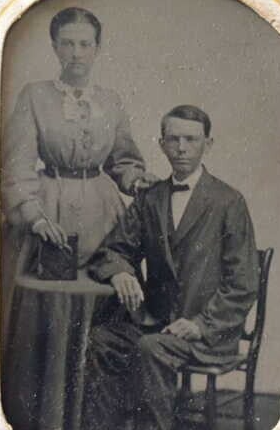
Through it all, Laura grew into a young woman of quiet strength. In 1867, at twenty, she married Mack Stewart, a man whose wartime scars lingered in his frail frame—his suit hanging loose on thinned legs, his eyes carrying shadows of prison camps or endless hunger. Laura stood in a faded photograph, her gown flowing like a dark river around her, her hand resting lightly on his shoulder. But joy was fleeting; Mack died in 1870, leaving Laura a widow at twenty-three, her heart tempered like steel in fire—grieving yet unbroken.
Like the resilient pines that withstood Georgia's fiercest storms, Laura endured. In 1878, she found love again with John Hartley, and their union brought two daughters whose laughter finally chased away some of the old shadows. She lived on, weaving resilience into every day, until March 1906, when at fifty-eight, she breathed her last. They laid her to rest in the family cemetery, now softened by moss and time, beneath the watchful branches of that same old oak—beside the mother who had cradled her and the father she never knew. In that radiant, unyielding land, Laura's life became a testament to quiet courage: a girl who grew up amid loss, yet found a way to hold on, to love, and to carry on.